


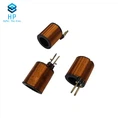


How does the number of turns in an Encapsulated Coil affect its performance?
As a supplier of Encapsulated Coils, I've witnessed firsthand the critical role that the number of turns plays in determining a coil's performance. Encapsulated coils are widely used in various applications, from automotive systems to industrial machinery, and understanding how the number of turns impacts their functionality is essential for both manufacturers and end - users.
Magnetic Field Strength
One of the most significant effects of the number of turns in an Encapsulated Coil is on the magnetic field strength it generates. According to Ampere's law, the magnetic field (B) inside a solenoid (a type of coil) is directly proportional to the product of the current (I), the number of turns per unit length (n), and the permeability of the medium (μ). The formula for the magnetic field inside a solenoid is (B=\mu nI).
When we increase the number of turns in an Encapsulated Coil, the value of n (number of turns per unit length) increases. Assuming the current remains constant, a higher n value leads to a stronger magnetic field. This is crucial in applications such as Solenoid Valve Coil, where the magnetic field is used to actuate a valve. A stronger magnetic field can provide a more reliable and faster response, ensuring that the valve opens or closes precisely when needed.
For example, in a hydraulic system, a solenoid valve coil with a sufficient number of turns can generate a strong magnetic field to overcome the hydraulic pressure and move the valve spool quickly. This improves the overall efficiency and performance of the hydraulic system.
Inductance
Inductance (L) is another important parameter affected by the number of turns in an Encapsulated Coil. The inductance of a coil is proportional to the square of the number of turns. The formula for the inductance of a solenoid is (L=\mu n^{2}A l), where A is the cross - sectional area of the coil and l is the length of the coil.
As the number of turns increases, the inductance of the coil increases significantly. Inductance is a measure of a coil's ability to store energy in its magnetic field. In electrical circuits, a coil with higher inductance will oppose changes in current more strongly. This property is used in applications such as filters and transformers.
In a power supply filter, an Encapsulated Coil with a high number of turns and thus high inductance can smooth out the ripples in the direct current. It stores energy during the peaks of the input current and releases it during the troughs, resulting in a more stable output voltage.


Resistance
The number of turns also affects the resistance of an Encapsulated Coil. Resistance (R) is given by the formula (R = \rho\frac{l}{A_{c}}), where (\rho) is the resistivity of the wire material, l is the length of the wire, and (A_{c}) is the cross - sectional area of the wire.
When the number of turns in a coil increases, the length of the wire used in the coil also increases. As a result, the resistance of the coil increases. A higher resistance can have both positive and negative impacts on the coil's performance.
On one hand, in some applications, such as heating elements, a higher resistance can be beneficial as it allows more electrical energy to be converted into heat. On the other hand, in applications where power efficiency is crucial, a high - resistance coil can lead to significant power losses in the form of heat. For example, in a motor, excessive resistance in the coils can reduce the motor's efficiency and cause overheating.
Frequency Response
The number of turns in an Encapsulated Coil can also influence its frequency response. In high - frequency applications, the self - capacitance of the coil becomes more significant. A coil with a large number of turns has a higher self - capacitance because there is more surface area of the wire in close proximity.
The self - capacitance forms a resonant circuit with the inductance of the coil. At the resonant frequency, the impedance of the coil reaches a minimum, which can cause problems in some applications. For example, in a radio frequency (RF) circuit, if the coil's resonant frequency coincides with the operating frequency of the circuit, it can lead to signal interference and reduced performance.
In low - frequency applications, the inductive reactance ((X_{L}=2\pi fL)) is the dominant factor. A coil with a large number of turns has a high inductance, which results in a high inductive reactance at low frequencies. This can be useful in applications such as audio transformers, where the coil needs to block or pass certain frequencies based on its inductive properties.
Heat Dissipation
As mentioned earlier, an increase in the number of turns can lead to an increase in resistance, which in turn causes more power to be dissipated as heat. Heat dissipation is a critical factor in the performance and reliability of an Encapsulated Coil.
Encapsulated coils are designed to protect the wire from environmental factors such as moisture, dust, and mechanical damage. However, the encapsulation material can also affect heat dissipation. If the number of turns is too high and the heat generated cannot be dissipated effectively, the temperature of the coil will rise.
Excessive temperature can cause the insulation of the wire to degrade, leading to short - circuits and reduced coil lifespan. Therefore, when designing an Encapsulated Coil, it is necessary to strike a balance between the number of turns required for the desired magnetic and electrical properties and the ability to dissipate heat.
Practical Considerations for Encapsulated Coil Design
As a supplier of Encapsulated Coils, I often work with customers to optimize the number of turns in their coils. Here are some practical considerations:
- Application Requirements: First and foremost, the application of the coil determines the desired magnetic field strength, inductance, and frequency response. For example, in a high - speed switching application, a coil with a lower number of turns may be preferred to reduce the inductance and allow for faster current changes.
- Space Constraints: The physical space available for the coil also affects the number of turns. In small - sized devices, it may not be possible to have a large number of turns. In such cases, alternative coil designs, such as Hollow Coils, may be considered.
- Cost: The cost of the coil is related to the amount of wire used. A coil with a large number of turns requires more wire, which increases the cost. Therefore, cost - effectiveness is an important factor in determining the number of turns.
If you are in the market for high - quality Encapsulated Coils and need assistance in determining the optimal number of turns for your specific application, please feel free to reach out. Our team of experts is ready to work with you to ensure that you get the best - performing coils for your needs. We can provide customized solutions based on your requirements and specifications.
References
- Halliday, D., Resnick, R., & Walker, J. (2014). Fundamentals of Physics. Wiley.
- Hayt, W. H., & Kemmerly, J. E. (2007). Engineering Circuit Analysis. McGraw - Hill.