


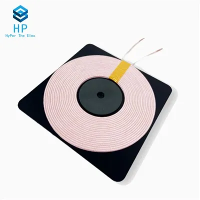


What is the magnetic permeability of an antenna coil core? Well, let me break it down for you. As a supplier of Antenna Coils, I've dealt with this topic quite a bit, and I'm excited to share what I know.
First off, magnetic permeability is a measure of how easily a magnetic field can pass through a material. In the context of an antenna coil core, it plays a crucial role in determining the performance of the coil. The core material's permeability affects the inductance of the coil, which in turn impacts the antenna's ability to transmit and receive signals.
Let's start by understanding the basics of an antenna coil. An antenna coil is a fundamental component in many electronic devices, used to convert electrical energy into electromagnetic waves and vice versa. The coil consists of a wire wound around a core, and the core material can significantly influence the coil's properties.
There are different types of antenna coils, such as Resonant Coil, Choke Coil, and Trap Coil. Each type has its own specific applications and requirements, and the magnetic permeability of the core is an important factor in their design.
The magnetic permeability of a material is denoted by the symbol μ (mu). It is a ratio of the magnetic flux density (B) in the material to the magnetic field strength (H) applied to it, i.e., μ = B/H. The permeability of free space, denoted as μ₀, is a constant value of approximately 4π × 10⁻⁷ H/m. Materials with a permeability greater than μ₀ are called ferromagnetic materials, while those with a permeability less than μ₀ are called diamagnetic materials.


For antenna coil cores, ferromagnetic materials are often preferred because they can enhance the magnetic field within the coil. This leads to an increase in inductance, which is beneficial for improving the antenna's performance. Some common ferromagnetic materials used for antenna coil cores include iron, nickel, and cobalt alloys.
The choice of core material depends on several factors, such as the operating frequency of the antenna, the required inductance, and the physical size of the coil. For low - frequency applications, materials with high permeability are usually used to achieve a large inductance with a relatively small number of turns. However, at high frequencies, the core material's losses can become significant, and materials with lower permeability but better high - frequency characteristics may be more suitable.
One important concept related to magnetic permeability is the relative permeability (μᵣ). It is the ratio of the permeability of a material (μ) to the permeability of free space (μ₀), i.e., μᵣ = μ/μ₀. Relative permeability gives us an idea of how much more easily a magnetic field can pass through a material compared to free space. For example, if a material has a relative permeability of 1000, it means that the magnetic field can pass through it 1000 times more easily than through free space.
When designing an antenna coil, we need to consider the trade - off between the inductance and the losses in the core. A high - permeability core can increase the inductance, but it may also introduce more losses due to eddy currents and hysteresis. Eddy currents are circulating currents induced in the core material by the changing magnetic field, and they can cause energy to be dissipated as heat. Hysteresis is the phenomenon where the magnetic field in the core lags behind the applied magnetic field, also resulting in energy losses.
To minimize these losses, we can use core materials with low electrical conductivity or with special laminations. Laminated cores are made up of thin sheets of magnetic material separated by insulating layers. This reduces the eddy currents by increasing the resistance to the current flow in the core.
Another factor to consider is the temperature dependence of the magnetic permeability. The permeability of most materials changes with temperature, and this can affect the performance of the antenna coil over a wide range of operating temperatures. Some materials have a more stable permeability over a certain temperature range, and these are often preferred for applications where temperature variations are significant.
In addition to the choice of core material, the shape and size of the core also play a role in determining the magnetic permeability and the overall performance of the antenna coil. Different core shapes, such as toroidal, cylindrical, and E - shaped, have different magnetic field distributions and characteristics. For example, a toroidal core has a closed magnetic path, which can reduce the magnetic leakage and improve the efficiency of the coil.
As an Antenna Coil supplier, we have a wide range of core materials and coil designs to meet the diverse needs of our customers. Whether you're working on a low - frequency radio project or a high - frequency wireless communication system, we can help you select the right antenna coil with the appropriate magnetic permeability.
If you're in the market for high - quality antenna coils, we'd love to have a chat with you. We can discuss your specific requirements, provide technical advice, and offer competitive pricing. Don't hesitate to reach out and start a conversation about your antenna coil needs.