


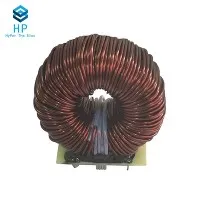


As a PFC inductor supplier, I've witnessed firsthand the rapid evolution of power electronics and the critical role that PFC inductors play in this dynamic field. PFC, or Power Factor Correction, is a technique used to improve the efficiency of electrical systems by reducing the reactive power and bringing the power factor closer to unity. PFC inductors are key components in this process, helping to smooth out current fluctuations and improve the overall performance of power supplies.
In recent years, the demand for more efficient, compact, and reliable PFC inductors has been on the rise. This is driven by a variety of factors, including the increasing adoption of renewable energy sources, the growth of electric vehicles, and the need for more energy-efficient consumer electronics. As a result, the search for new materials that can meet these evolving requirements has become a top priority for researchers and manufacturers alike.
Current Materials and Their Limitations
Before we explore the potential new materials for PFC inductors, let's first take a look at the current materials commonly used in their construction. The most widely used materials for PFC inductors are ferrite cores and powdered iron cores.
Ferrite cores are made from a ceramic material composed of iron oxide and other metal oxides. They offer high magnetic permeability, low core losses, and excellent high-frequency performance. Ferrite cores are commonly used in applications where high efficiency and low electromagnetic interference (EMI) are required. However, they have a relatively low saturation flux density, which limits their use in high-power applications.
Powdered iron cores, on the other hand, are made from a mixture of iron powder and a binder material. They have a higher saturation flux density than ferrite cores, making them suitable for high-power applications. However, they also have higher core losses at high frequencies, which can reduce the overall efficiency of the inductor.
New Materials for PFC Inductors
To overcome the limitations of current materials, researchers are exploring a variety of new materials for PFC inductors. Here are some of the most promising materials that could be used in the future:
Nanocrystalline Alloys
Nanocrystalline alloys are a type of soft magnetic material that consists of nanoscale crystalline grains embedded in an amorphous matrix. They offer high magnetic permeability, low core losses, and excellent high-frequency performance. Nanocrystalline alloys have a much higher saturation flux density than ferrite cores, making them suitable for high-power applications. They also have a lower coercivity, which means they can be magnetized and demagnetized more easily, reducing the energy losses in the inductor.
Amorphous Metals
Amorphous metals, also known as metallic glasses, are a type of non-crystalline metal that has a disordered atomic structure. They offer high magnetic permeability, low core losses, and excellent high-frequency performance. Amorphous metals have a much higher saturation flux density than ferrite cores, making them suitable for high-power applications. They also have a lower coercivity, which means they can be magnetized and demagnetized more easily, reducing the energy losses in the inductor.
Soft Magnetic Composites (SMCs)
Soft magnetic composites (SMCs) are a type of magnetic material that consists of magnetic powder particles coated with an insulating material. They offer high magnetic permeability, low core losses, and excellent high-frequency performance. SMCs have a much higher saturation flux density than ferrite cores, making them suitable for high-power applications. They also have a lower coercivity, which means they can be magnetized and demagnetized more easily, reducing the energy losses in the inductor.
Graphene
Graphene is a two-dimensional material made of a single layer of carbon atoms arranged in a hexagonal lattice. It offers excellent electrical conductivity, high mechanical strength, and good thermal conductivity. Graphene has the potential to be used as a conductor in PFC inductors, replacing traditional copper or aluminum wires. This could reduce the resistance of the inductor, improving its efficiency and reducing its size.


Benefits of Using New Materials
The use of new materials in PFC inductors offers several benefits, including:
Higher Efficiency
New materials such as nanocrystalline alloys, amorphous metals, and SMCs offer lower core losses than traditional materials, which can improve the overall efficiency of the inductor. This can lead to significant energy savings, especially in high-power applications.
Higher Power Density
New materials such as nanocrystalline alloys, amorphous metals, and SMCs have a higher saturation flux density than traditional materials, which means they can handle higher currents without saturating. This allows for the design of smaller and more compact inductors, which can save space and reduce the cost of the overall system.
Improved High-Frequency Performance
New materials such as nanocrystalline alloys, amorphous metals, and SMCs offer excellent high-frequency performance, which is essential for modern power electronics applications. This can reduce the electromagnetic interference (EMI) generated by the inductor, improving the reliability and performance of the overall system.
Challenges and Considerations
While the use of new materials in PFC inductors offers many benefits, there are also some challenges and considerations that need to be addressed. These include:
Cost
New materials such as nanocrystalline alloys, amorphous metals, and SMCs are generally more expensive than traditional materials such as ferrite cores and powdered iron cores. This can increase the cost of the inductor, which may limit its adoption in some applications.
Manufacturing Complexity
New materials such as nanocrystalline alloys, amorphous metals, and SMCs require specialized manufacturing processes, which can be more complex and expensive than traditional manufacturing processes. This can increase the cost of the inductor and make it more difficult to produce in large quantities.
Compatibility with Existing Systems
New materials such as nanocrystalline alloys, amorphous metals, and SMCs may have different magnetic properties and electrical characteristics than traditional materials. This can make it challenging to integrate them into existing systems without making significant modifications.
Conclusion
The future of PFC inductors looks promising, with the development of new materials that offer higher efficiency, higher power density, and improved high-frequency performance. While there are still some challenges and considerations that need to be addressed, the potential benefits of using new materials in PFC inductors are significant. As a PFC inductor supplier, we are committed to staying at the forefront of this technology and offering our customers the latest and most innovative solutions.
If you are interested in learning more about our PFC inductors or discussing your specific requirements, please visit our website at PFC Inductor. We also offer a wide range of other inductors, including Filter Inductor and BUCK Inductor. Contact us today to start a conversation about how we can help you meet your power electronics needs.
References
- [1] C. M. Rashid, Power Electronics: Circuits, Devices, and Applications, 4th ed., Prentice Hall, 2010.
- [2] M. H. Rashid, Power Electronics Handbook, 3rd ed., Academic Press, 2017.
- [3] R. W. Erickson and D. Maksimovic, Fundamentals of Power Electronics, 3rd ed., Springer, 2017.