



In the field of electromagnetic applications, the resonant coil stands as a crucial component, playing a fundamental role in various devices such as wireless charging systems, radio frequency identification (RFID) devices, and even some high - tech medical equipment. As a dedicated resonant coil supplier, I've spent countless hours researching and experimenting to understand how different factors affect the performance of these coils. One of the most significant factors that has caught my attention is the shape of the resonant coil. In this blog, I'll delve deep into how the shape of a resonant coil impacts its performance.
Basics of Resonant Coils
Before we explore the influence of shape, let's briefly go through the basics of resonant coils. A resonant coil, as the name suggests, operates at a specific resonant frequency. When an alternating current passes through the coil, it creates a magnetic field. The interaction between this magnetic field and the electrical properties of the coil, such as inductance (L) and capacitance (C), determines the resonant frequency according to the formula (f = \frac{1}{2\pi\sqrt{LC}}).
The performance of a resonant coil is typically evaluated based on several parameters. These include the quality factor (Q), which represents the ratio of energy stored in the coil to the energy dissipated per cycle; the resonant frequency, which needs to be precisely tuned in many applications; and the coupling coefficient, which is important in wireless power transfer scenarios, indicating how effectively the magnetic field can transfer energy between coils.
The Effect of Circular Coils
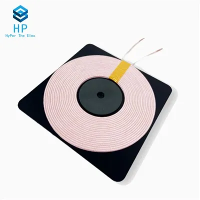
Circular coils are perhaps the most common shape used in resonant coil applications. One of the main advantages of circular coils is their symmetry. The magnetic field generated by a circular coil is relatively uniform in the central region. This uniformity is beneficial in applications where a stable magnetic field is required. For example, in some wireless charging pads for smartphones, circular resonant coils are used to ensure that the charging process is consistent regardless of the exact position of the phone on the pad.
The circular shape also has a relatively high self - inductance compared to some other shapes for a given number of turns and wire length. A higher inductance can increase the resonant frequency range that the coil can cover when combined with an appropriate capacitor. However, circular coils also have some drawbacks. As the radius of the circular coil increases, the magnetic field strength at the outer edges decreases more rapidly compared to the central region. This non - linear magnetic field distribution can lead to sub - optimal performance in applications where a more evenly distributed magnetic field is needed over a larger area.
You can find high - quality circular resonant coils in our Resonant Coil product line. Our circular coils are carefully designed to maximize the uniformity of the magnetic field and the quality factor within a specific size and cost range.
The Impact of Square Coils
Square coils offer a different set of characteristics compared to circular ones. The shape of a square coil makes it easier to fit into rectangular or square - shaped devices, which is a practical advantage in many modern electronic products where space utilization is crucial. For instance, in some RFID tags that are designed to be integrated into small, square - shaped packages, square resonant coils are often used.
In terms of magnetic field distribution, square coils have a more concentrated magnetic field at the corners. This can be both an advantage and a disadvantage. In some coupling applications, the concentrated magnetic field at the corners can enhance the coupling coefficient with another coil placed in a specific orientation. However, the non - uniform magnetic field distribution across the entire coil area may lead to inconsistent performance if the relative position between the coil and other components changes.
Another aspect is the self - inductance of square coils. Generally, for the same perimeter or number of turns as a circular coil, a square coil has a slightly lower self - inductance. This lower inductance value needs to be taken into account when designing the resonant circuit, especially when aiming for a specific resonant frequency.
Rectangular Coils and Their Properties
Rectangular coils are a variation of square coils, but with different side lengths. They are often used in applications where the available space has an elongated or irregular rectangular shape. For example, in some portable electronic devices where the internal layout requires a long and narrow coil, rectangular resonant coils are a suitable choice.
The magnetic field distribution of rectangular coils is similar to that of square coils, with a more concentrated field at the corners. However, the aspect ratio of the rectangle (the ratio of the long side to the short side) can significantly affect the magnetic field pattern. A larger aspect ratio can result in a more pronounced difference in magnetic field strength between the long and short sides of the coil.
From an electrical performance perspective, the self - inductance of a rectangular coil is also influenced by its aspect ratio. A higher aspect ratio usually leads to a lower self - inductance value compared to a square coil with the same perimeter. This characteristic can be utilized in circuit design to fine - tune the resonant frequency and other electrical parameters.
Complicated Shapes and Their Unique Effects
In addition to the basic shapes (circular, square, and rectangular), there are also more complicated or custom - designed resonant coil shapes. These shapes are often developed to meet specific application requirements. For example, in some wireless power transfer systems that need to transfer power around obstacles or in a non - linear path, coils with irregular or bent shapes can be designed.
One such example is the spiral coil. Spiral coils can have a planar or three - dimensional structure. Planar spiral coils are commonly used in printed circuit boards (PCBs) due to their ease of fabrication. They can provide a relatively high inductance value in a small area. The magnetic field of a spiral coil is concentrated in the center of the spiral, and the outer turns mainly contribute to increasing the inductance.
Three - dimensional spiral coils, on the other hand, can generate a more complex magnetic field distribution. They are often used in applications that require a stronger magnetic field within a specific volume, such as some high - power wireless charging systems or magnetic resonance imaging (MRI) devices.
Impact on Performance Parameters
The shape of the resonant coil has a profound impact on various performance parameters.
Quality Factor (Q)
The quality factor is highly influenced by the shape of the coil. Coils with a more uniform current distribution tend to have a higher Q value. Circular coils generally have a relatively high Q because the current flows evenly around the circumference. In contrast, square and rectangular coils may have a lower Q due to the non - uniform current distribution, especially at the corners where the current can be more concentrated. Complicated shapes like spiral coils can also have a high Q if they are designed to minimize resistive losses and maximize the energy storage.
Resonant Frequency
As mentioned earlier, the self - inductance of the coil is a key factor in determining the resonant frequency. Different shapes have different self - inductance values for the same wire length and number of turns. Therefore, the shape directly affects the resonant frequency of the coil. Designers need to carefully consider the shape when aiming for a specific resonant frequency in a circuit.
Coupling Coefficient
In wireless power transfer applications, the coupling coefficient between the transmitting and receiving coils is of utmost importance. The shape of the coils can significantly affect this coefficient. For example, if the shapes of the transmitting and receiving coils are well - matched, such as two circular coils facing each other, the coupling coefficient can be relatively high. However, if the shapes are mismatched, the coupling efficiency may be reduced.


Conclusion
As a resonant coil supplier, I understand the critical role that the shape of a resonant coil plays in its performance. Different shapes offer unique advantages and disadvantages in terms of magnetic field distribution, self - inductance, quality factor, resonant frequency, and coupling coefficient. By carefully selecting the appropriate coil shape based on the specific requirements of an application, designers can optimize the performance of their electromagnetic devices.
Whether you are working on a wireless charging project, an RFID system, or any other application that requires a resonant coil, our company can provide you with a wide range of coil shapes to meet your needs. We have a team of experienced engineers who can help you choose the most suitable coil shape and customize it if necessary. If you are interested in purchasing resonant coils or have any questions about coil design and performance, please feel free to contact us for further discussion and negotiation. We look forward to working with you to create high - performance electromagnetic solutions.
References
- "Electromagnetic Fields and Waves" by Cheng, D. K.
- "RF Circuit Design" by Chris Bowick
- Research papers on wireless power transfer and resonant coil applications in IEEE Xplore Digital Library