


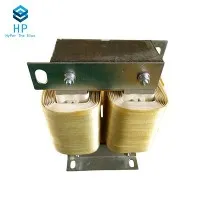



Evaluating the impact of an Output Reactor on the electrical network is a critical task for electrical engineers,system operators,and facility managers. As a reputable Output Reactor supplier,we understand the significance of this evaluation and are committed to providing high - quality products and in - depth technical support.
1. Understanding the Basics of Output Reactors
Output reactors,also known as load reactors,are inductive components installed between the output of a variable - frequency drive (VFD) and the motor. Their primary function is to reduce the peak voltage and current spikes generated by the VFD. These spikes are a result of the high - frequency switching operation of the VFD,which can cause insulation damage to the motor windings,electromagnetic interference (EMI),and premature motor failure.
The inductance of an output reactor is measured in henries (H),and it plays a crucial role in determining the reactor's performance. A higher inductance value can provide better filtering of high - frequency components,but it may also introduce additional voltage drop in the electrical circuit.


2. Impact on Motor Performance
- Insulation Protection
One of the most significant impacts of an output reactor on the electrical network is the protection of the motor's insulation. The high - frequency voltage spikes generated by the VFD can create a phenomenon called "voltage reflection" in the motor cables. This reflection can cause the voltage at the motor terminals to be much higher than the rated voltage of the motor,leading to insulation breakdown over time.
An output reactor helps to dampen these voltage spikes and reduce the amplitude of the reflected waves. By doing so,it extends the lifespan of the motor insulation and reduces the risk of costly motor failures. For example,in industrial applications where motors operate continuously for long periods,using an output reactor can significantly improve the reliability of the motor system.
- Torque and Speed Regulation
Output reactors can also affect the torque and speed regulation of the motor. The inductance of the reactor can cause a phase shift between the voltage and current in the motor circuit. This phase shift can change the effective impedance of the motor and,therefore,its torque - speed characteristics.
In some cases,a proper selection of the output reactor can help to optimize the motor's torque - speed curve,resulting in more efficient operation. However,incorrect sizing of the reactor can lead to reduced motor performance,including decreased torque and slower acceleration.
3. Impact on Power Quality
- Harmonic Reduction
Variable - frequency drives are known to generate harmonics in the electrical network. Harmonics are unwanted frequency components that can distort the sinusoidal waveform of the voltage and current. These harmonics can cause overheating of transformers,generators,and other electrical equipment,reduce the efficiency of the power system,and interfere with the operation of sensitive electronic devices.
Output reactors can act as a low - pass filter for high - frequency harmonics. By reducing the amplitude of the harmonics,they improve the power quality of the electrical network. For instance,in a commercial building with multiple VFD - driven air - conditioning systems,installing output reactors can significantly reduce the harmonic distortion of the electrical supply,ensuring the proper operation of other electrical loads in the building.
- Electromagnetic Interference (EMI) Mitigation
The high - frequency switching operation of VFDs can radiate electromagnetic energy,leading to electromagnetic interference (EMI). EMI can disrupt the operation of nearby electronic devices,such as communication systems,control panels,and sensors.
Output reactors can help to contain the electromagnetic fields generated by the VFD. They act as a barrier,reducing the amount of EMI that is radiated into the surrounding environment. This is particularly important in industrial settings,where a large number of electronic devices are operating in close proximity.
4. System - Level Impact
- Voltage Drop
When evaluating the impact of an output reactor on the electrical network,voltage drop is an important consideration. The inductance of the reactor causes a voltage drop across it,especially at high frequencies and high loads.
Excessive voltage drop can result in reduced motor performance and inefficient operation. Therefore,it is crucial to select an output reactor with an appropriate inductance value to minimize the voltage drop while still achieving the desired filtering and protection functions. Electrical engineers typically calculate the voltage drop based on the reactor's inductance,the current flowing through it,and the system frequency.
- Interaction with Other Components
Output reactors do not operate in isolation. They interact with other components in the electrical network,such as transformers,capacitors,and other reactors. These interactions can have both positive and negative effects on the overall performance of the system.
For example,an output reactor may interact with a power factor correction capacitor bank. If the combination of the reactor and the capacitor bank is not properly designed,it can cause resonance in the electrical system,leading to excessive voltage and current oscillations. Therefore,careful consideration must be given to the interaction between the output reactor and other components during the system design phase.
5. Different Types of Reactors and Their Impacts
There are several types of reactors that are relevant to the electrical network,including Series Resonant Reactor, Saturated Reactor, and Variable Reactor.
- Series Resonant Reactor
A series resonant reactor is designed to resonate at a specific frequency. When used in combination with a capacitor,it can create a resonant circuit that can selectively filter out certain harmonics. In an electrical network with significant harmonic distortion,a series resonant reactor can be an effective solution to improve power quality. - Saturated Reactor
Saturated reactors are used to control the current flow in an electrical circuit. They have a non - linear characteristic,where the inductance changes with the current. This property makes them suitable for applications where variable impedance is required,such as in some types of motor control systems. - Variable Reactor
Variable reactors allow for the adjustment of the inductance value. This flexibility makes them useful in applications where the electrical load varies significantly over time. For example,in a power grid with fluctuating loads,a variable reactor can be adjusted to maintain the desired power factor and voltage level.
6. Methods for Evaluating the Impact
- Simulation Tools
Modern electrical simulation software,such as ETAP,PSCAD,and MATLAB/Simulink,can be used to model the electrical network and the output reactor. These tools allow engineers to simulate different operating conditions and analyze the impact of the reactor on motor performance,power quality,and system stability. - Field Measurements
Field measurements are essential for validating the simulation results and obtaining real - world data. Electrical engineers can use instruments such as power analyzers,oscilloscopes,and current transformers to measure the voltage,current,power,and harmonic content in the electrical network before and after the installation of the output reactor.
7. Conclusion
In conclusion,evaluating the impact of an Output Reactor on the electrical network is a complex but essential task. An output reactor can have a significant impact on motor performance,power quality,and system stability. By understanding the basics of output reactors,considering their impact on different aspects of the electrical network,and using appropriate evaluation methods,it is possible to select and install the right output reactor for a specific application.
As a leading Output Reactor supplier,we have the expertise and experience to help you navigate the process of evaluating the impact of our reactors on your electrical network. If you are considering implementing an Output Reactor in your system,we encourage you to contact us for a detailed consultation. Our team of experts can provide you with customized solutions based on your specific requirements and help you achieve optimal performance and reliability in your electrical network.
References
- Alexander, C. K., & Sadiku, M. N. O. (2017). Fundamentals of Electric Circuits. McGraw - Hill Education.
- Dorf, R. C., & Svoboda, J. A. (2016). Introduction to Electric Circuits. Wiley.
- Grainger, J. J., & Stevenson, W. D. (1994). Power System Analysis. McGraw - Hill.