


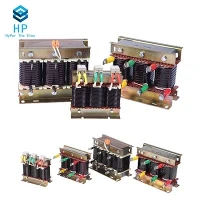
As a seasoned supplier of Saturated Reactors, I've witnessed firsthand the critical role these components play in various electrical systems. In this blog post, I'll delve into the main components of a saturated reactor, shedding light on their functions and significance. Whether you're an engineer, technician, or simply curious about electrical engineering, this guide will provide valuable insights into the inner workings of saturated reactors.


Core
The core is the heart of a saturated reactor, serving as the magnetic path for the flow of magnetic flux. It is typically made of a high-permeability magnetic material, such as silicon steel or ferrite, which allows for efficient magnetic coupling between the windings. The core is designed to saturate at a certain magnetic field strength, which is a key characteristic of saturated reactors.
When the core saturates, its permeability decreases significantly, causing the inductance of the reactor to change. This property is exploited in saturated reactors to control the flow of current in an electrical circuit. By varying the DC bias current applied to the control winding, the saturation level of the core can be adjusted, thereby changing the impedance of the reactor.
Windings
A saturated reactor typically consists of two main windings: the main winding and the control winding.
Main Winding
The main winding is responsible for carrying the alternating current (AC) in the electrical circuit. It is usually wound around the core and is designed to have a high inductance when the core is in an unsaturated state. The main winding is connected in series or parallel with the load, depending on the specific application.
When an AC voltage is applied to the main winding, a magnetic field is generated in the core. The strength of the magnetic field is proportional to the current flowing through the main winding. If the magnetic field exceeds the saturation point of the core, the core will saturate, and the inductance of the main winding will decrease.
Control Winding
The control winding is used to control the saturation level of the core. It is also wound around the core and is connected to a DC power source. By applying a DC current to the control winding, a magnetic field is generated in the core that opposes or reinforces the magnetic field generated by the main winding.
By controlling the magnitude and direction of the DC current in the control winding, the saturation level of the core can be adjusted. This, in turn, affects the inductance of the main winding and the flow of current in the electrical circuit. The control winding provides a means of external control over the operation of the saturated reactor.
Bias Circuit
The bias circuit is an essential component of a saturated reactor, as it provides the DC bias current to the control winding. The bias circuit typically consists of a DC power source, such as a battery or a regulated DC power supply, and a resistor or a variable resistor to control the magnitude of the bias current.
The bias current is used to set the operating point of the saturated reactor, i.e., the initial saturation level of the core. By adjusting the bias current, the reactor can be made to operate in different modes, such as linear or non-linear modes, depending on the requirements of the application.
Cooling System
In high-power applications, saturated reactors can generate a significant amount of heat due to the losses in the core and the windings. To prevent overheating and ensure reliable operation, a cooling system is often required.
The cooling system can be either air-cooled or liquid-cooled, depending on the power rating and the application requirements. Air-cooled systems use fans to blow air over the reactor to dissipate the heat, while liquid-cooled systems circulate a cooling fluid, such as water or oil, through channels in the reactor to remove the heat.
Protective Devices
To ensure the safe and reliable operation of saturated reactors, various protective devices are often incorporated into the design. These devices include fuses, circuit breakers, overcurrent relays, and temperature sensors.
Fuses and circuit breakers are used to protect the reactor from excessive current, which can cause overheating and damage to the windings. Overcurrent relays monitor the current flowing through the reactor and trip the circuit breaker if the current exceeds a predefined threshold. Temperature sensors are used to monitor the temperature of the reactor and activate an alarm or shut down the reactor if the temperature exceeds a safe limit.
Applications of Saturated Reactors
Saturated reactors have a wide range of applications in electrical engineering, including:
- Power Factor Correction: Saturated reactors can be used to improve the power factor of electrical systems by adjusting the phase angle between the voltage and current.
- Voltage Regulation: They can be used to regulate the voltage in electrical networks by controlling the impedance of the reactor.
- Harmonic Filtering: Saturated reactors can be used to filter out harmonics from electrical systems, reducing the interference and improving the quality of the power supply.
- Arc Furnace Control: In arc furnace applications, saturated reactors are used to control the current and voltage, ensuring stable and efficient operation of the furnace.
Conclusion
In conclusion, saturated reactors are complex electrical components that play a crucial role in various electrical systems. The main components of a saturated reactor include the core, windings, bias circuit, cooling system, and protective devices. Understanding the function and operation of these components is essential for the design, installation, and maintenance of saturated reactors.
As a supplier of Saturated Reactor, we are committed to providing high-quality products and excellent customer service. Our reactors are designed and manufactured to meet the highest standards of performance and reliability, and we offer a wide range of options to suit different applications and requirements.
If you're interested in learning more about our Saturated Reactors or have any questions about their application, please don't hesitate to contact us. We look forward to working with you to find the right solution for your electrical needs.
In addition to Saturated Reactors, we also offer a variety of other types of reactors, including Output Reactor, Variable Reactor, Parallel Resonant Reactor, and Series Resonant Reactor. These reactors are designed to meet the specific needs of different applications and provide reliable and efficient performance.
If you're considering purchasing any of these reactors, we encourage you to reach out to us for a detailed discussion. Our team of experts is always ready to assist you in selecting the right product for your project and providing you with the necessary technical support.