


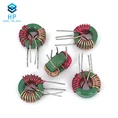

When it comes to selecting an inductor, there are numerous parameters that one must take into account. As an inductor supplier, I understand the critical role that inductors play in various electronic circuits and the importance of choosing the right one for specific applications. In this blog post, I will delve into the key parameters that should be considered when selecting an inductor.
Inductance Value
The inductance value is perhaps the most fundamental parameter of an inductor. It is measured in henries (H) and represents the ability of the inductor to store energy in a magnetic field when a current flows through it. The required inductance value depends on the specific application. For example, in power supply circuits, the inductance value affects the output ripple and the ability to handle current. A higher inductance value can reduce the ripple current, but it may also increase the size and cost of the inductor. In radio frequency (RF) circuits, the inductance value is crucial for tuning the resonant frequency of the circuit.
Tolerance
Tolerance refers to the allowable deviation of the actual inductance value from the nominal value. It is expressed as a percentage. For example, an inductor with a 10% tolerance means that the actual inductance value can be within 10% of the nominal value. In applications where precise inductance values are required, such as in high - frequency filters or oscillators, a lower tolerance inductor is preferred. However, lower tolerance inductors are generally more expensive.
Current Rating
The current rating of an inductor is the maximum current that the inductor can carry without overheating or experiencing significant changes in its electrical properties. It is an important parameter, especially in power applications. When the current exceeds the rated value, the inductor may saturate, which means that the inductance value will decrease significantly. This can lead to increased ripple current, reduced efficiency, and even damage to the inductor. The current rating is affected by factors such as the core material, the number of turns, and the wire gauge.


DC Resistance (DCR)
The DC resistance of an inductor is the resistance of the wire used to wind the inductor. It is an important parameter because it affects the power loss in the inductor. When a current flows through the inductor, power is dissipated as heat due to the resistance of the wire. A lower DCR means less power loss and higher efficiency. In power supply applications, minimizing the DCR can improve the overall efficiency of the circuit.
Core Material
The core material of an inductor has a significant impact on its performance. Different core materials have different magnetic properties, such as permeability, saturation flux density, and core loss. Common core materials include ferrite, iron powder, and laminated cores.
- Ferrite Cores: Ferrite cores have high permeability, which means they can store a large amount of magnetic energy in a relatively small volume. They also have low core losses at high frequencies, making them suitable for RF applications and high - frequency power supplies.
- Iron Powder Cores: Iron powder cores have a lower permeability compared to ferrite cores, but they can handle higher currents without saturating. They are commonly used in power applications where high current handling is required.
- Laminated Cores: Laminated cores are made of thin layers of magnetic material separated by insulating layers. They are suitable for low - frequency applications, such as power transformers, because they can reduce eddy current losses.
Self - Resonant Frequency (SRF)
The self - resonant frequency of an inductor is the frequency at which the inductance and the parasitic capacitance of the inductor form a resonant circuit. At the SRF, the impedance of the inductor reaches a maximum value. Above the SRF, the inductor behaves more like a capacitor. In applications where the inductor is used at high frequencies, it is important to choose an inductor with a SRF higher than the operating frequency to avoid resonance problems.
Temperature Coefficient
The temperature coefficient of an inductor describes how the inductance value changes with temperature. It is expressed in parts per million per degree Celsius (ppm/°C). In applications where the operating temperature varies significantly, it is important to choose an inductor with a low temperature coefficient to ensure stable performance.
Size and Package
The size and package of an inductor are also important considerations, especially in applications where space is limited. Smaller inductors are often preferred in portable devices and compact electronic circuits. However, smaller inductors may have limitations in terms of current handling and inductance value. The package type also affects the ease of mounting and the thermal performance of the inductor.
Applications and Examples
Let's take a look at some specific applications and how the above parameters are considered.
Power Supply Circuits
In power supply circuits, such as switching power supplies, the inductor is used to store and release energy. The inductance value is chosen based on the desired output ripple and the switching frequency. A higher inductance value can reduce the ripple current, but it may also increase the size of the inductor. The current rating is crucial to ensure that the inductor can handle the load current without saturating. The DCR should be minimized to reduce power loss and improve efficiency. For example, a PFC Inductor is commonly used in power factor correction circuits to improve the power factor of the power supply.
RF Circuits
In RF circuits, such as radio receivers and transmitters, the inductor is used for tuning and filtering. The inductance value is carefully selected to achieve the desired resonant frequency. The SRF should be higher than the operating frequency to avoid resonance problems. Ferrite cores are often used in RF inductors due to their high permeability and low core losses at high frequencies. For instance, a Coil Inductor can be used in an RF filter circuit to select a specific frequency band.
Three - Phase Power Systems
In three - phase power systems, Three - phase Inductor are used for various purposes, such as filtering and energy storage. The inductance value and current rating are important parameters to ensure proper operation of the system. The core material is chosen based on the specific requirements of the application, such as high current handling or low core losses.
Conclusion
Selecting the right inductor is a complex process that requires careful consideration of multiple parameters. As an inductor supplier, we understand the importance of providing high - quality inductors that meet the specific needs of our customers. Whether you are designing a power supply, an RF circuit, or a three - phase power system, we can offer a wide range of inductors with different specifications to suit your requirements.
If you are interested in purchasing inductors for your projects, please feel free to contact us for more information and to discuss your specific needs. We are committed to providing excellent products and services to help you achieve the best performance in your applications.