




In the vast landscape of electronic circuits, coil inductors stand as fundamental components, playing crucial roles that are often overlooked but are indispensable for the proper functioning of various devices. As a dedicated coil inductor supplier, I've witnessed firsthand the diverse applications and the vital functions these components serve. In this blog, I'll delve into the functions of a coil inductor in a circuit, exploring its significance and how it contributes to the overall performance of electronic systems.
1. Energy Storage and Release
One of the primary functions of a coil inductor is its ability to store and release energy. When an electric current flows through an inductor, a magnetic field is generated around the coil. This magnetic field stores energy in a form similar to how a capacitor stores energy in an electric field. According to Faraday's law of electromagnetic induction, the induced electromotive force (EMF) in the inductor is proportional to the rate of change of current. As the current through the inductor changes, the magnetic field also changes, and the inductor either stores or releases energy accordingly.
In DC circuits, when the current is constant, the inductor acts as a simple conductor with minimal resistance. However, when the current is switched on or off, the inductor resists the change in current. For example, when the power supply is suddenly turned off, the inductor tries to maintain the current flow by releasing the stored energy in the magnetic field. This property is utilized in applications such as switching power supplies, where inductors are used to smooth out the output voltage and reduce ripple.
2. Filtering
Coil inductors are widely used in filtering applications to remove unwanted frequencies from a signal. In combination with capacitors, inductors form passive filters that can be designed to allow certain frequencies to pass through while blocking others. There are two main types of filters: low - pass filters and high - pass filters.
A low - pass filter allows low - frequency signals to pass through while attenuating high - frequency signals. In a low - pass filter circuit, an inductor is connected in series with the load, and a capacitor is connected in parallel. The inductor opposes the change in current caused by high - frequency signals, effectively blocking them, while allowing low - frequency signals to pass. On the other hand, a high - pass filter allows high - frequency signals to pass and blocks low - frequency signals. In this case, the inductor is connected in parallel with the load, and the capacitor is in series.
Filter inductors are essential in many electronic devices, such as audio systems, where they are used to separate different frequency components of the audio signal. For more information on filter inductors, you can visit our Filter Inductor page.
3. Impedance Matching
Impedance matching is another important function of coil inductors. In electronic circuits, impedance is the opposition to the flow of alternating current. When the impedance of a source and a load are not matched, a significant amount of power can be reflected back to the source, resulting in reduced efficiency and signal distortion.
Inductors can be used to adjust the impedance of a circuit to match the source and the load. By carefully selecting the inductance value, the impedance of the inductor can be made to cancel out the reactive component of the load impedance, achieving a better match. This is particularly important in high - frequency circuits, such as radio frequency (RF) systems, where impedance matching is crucial for maximizing power transfer and minimizing signal loss.
4. Power Factor Correction (PFC)
In electrical power systems, power factor is a measure of how effectively electrical power is being used. A low power factor can lead to increased energy consumption, higher electricity bills, and additional stress on the power distribution system. Coil inductors play a vital role in power factor correction (PFC) circuits.
In a PFC circuit, an inductor is used to shape the input current waveform to be in phase with the input voltage waveform. This is achieved by storing and releasing energy in the inductor at the appropriate times during the AC cycle. By improving the power factor, PFC inductors help to reduce the reactive power in the system, resulting in more efficient use of electrical energy. For more details on PFC inductors, you can refer to our PFC Inductor page.
5. Inductive Coupling
Inductive coupling is a phenomenon where the magnetic field generated by one inductor induces a current in another nearby inductor. This principle is used in transformers, which are essentially two or more inductors wound on a common core.


Transformers are used to step up or step down the voltage in an AC circuit. When an alternating current flows through the primary winding (input inductor), it creates a changing magnetic field that induces an electromotive force in the secondary winding (output inductor). The ratio of the number of turns in the primary and secondary windings determines the voltage transformation ratio.
Inductive coupling is also used in wireless power transfer systems, where a primary inductor in the charging station creates a magnetic field that induces a current in a secondary inductor in the device being charged.
6. Types of Coil Inductors and Their Specific Functions
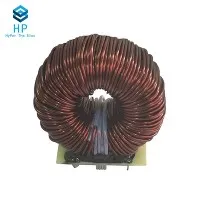
There are various types of coil inductors, each with its own unique characteristics and functions. One common type is the toroidal inductor. Toroidal inductors are wound on a doughnut - shaped core, which provides a closed magnetic path. This design reduces the magnetic field leakage and offers high inductance values in a relatively small size.
Toroidal inductors are often used in applications where space is limited and high performance is required, such as in switch - mode power supplies and audio amplifiers. To learn more about toroidal inductors, visit our Toroidal Inductors page.
Conclusion
As a coil inductor supplier, I understand the importance of these components in modern electronic circuits. From energy storage and filtering to power factor correction and inductive coupling, coil inductors play a wide range of functions that are essential for the proper operation of countless electronic devices.
Whether you are designing a new electronic product or looking to improve the performance of an existing one, choosing the right coil inductor is crucial. Our company offers a wide range of high - quality coil inductors, including PFC inductors, filter inductors, and toroidal inductors, to meet your specific requirements.
If you are interested in our products or have any questions about coil inductors, we encourage you to contact us for a procurement discussion. Our team of experts is ready to assist you in selecting the most suitable inductors for your applications.
References
- Paul, Clayton R. "Introduction to Electromagnetic Compatibility." Wiley, 2006.
- Alexander, Charles K., and Matthew N. O. Sadiku. "Fundamentals of Electric Circuits." McGraw - Hill, 2012.
- Grover, Frederick W. "Inductance Calculations: Working Formulas and Tables." Dover Publications, 1946.