



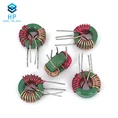

Hey there! I'm a supplier of toroidal inductors, and today I'm gonna chat about the function of a shielded toroidal inductor.
First off, let's understand what a shielded toroidal inductor is. A toroidal inductor is basically a coil of wire wound around a doughnut - shaped (toroid) core. The shielding part adds an extra layer that helps to contain the magnetic field generated by the inductor.
1. Energy Storage
One of the main functions of a shielded toroidal inductor is energy storage. When an electric current flows through the coil of the inductor, a magnetic field is created around it. The energy from the electric current is then stored in this magnetic field. This stored energy can be released back into the circuit when the current flow changes.
For instance, in power supply circuits, the shielded toroidal inductor can store energy during the time when the power is being supplied. When the power input briefly drops or needs to be regulated, the inductor can release the stored energy to keep the circuit functioning smoothly. This helps in providing a stable power output, which is crucial for the proper operation of many electronic devices.
2. Filtering
Shielded toroidal inductors are also excellent for filtering purposes. In electrical circuits, there can be all sorts of unwanted signals such as noise and interference. The inductor can act as a filter to block high - frequency signals while allowing low - frequency or DC (direct current) signals to pass through.
Take a look at Filter Inductor. These inductors are often used in power supplies and audio systems to get rid of the unwanted high - frequency noise. In a power supply, the inductor can filter out the ripple voltage (small fluctuations in the DC output). In an audio system, it can prevent high - frequency interference from distorting the sound quality.
3. Impedance Matching
Another important function is impedance matching. In electrical circuits, different components may have different impedance values. Impedance is like the electrical resistance to the flow of alternating current. When the impedance of different parts of a circuit is not matched, it can lead to signal reflections and loss of power.
A shielded toroidal inductor can be used to adjust the impedance of a circuit to match that of other components. For example, in radio frequency (RF) circuits, impedance matching is crucial for efficient signal transfer between the antenna, amplifier, and other components. By using a properly designed shielded toroidal inductor, the impedance of the circuit can be fine - tuned to ensure maximum power transfer and minimal signal loss.
4. Inductive Reactance
The shielded toroidal inductor has a property called inductive reactance. Inductive reactance is a form of opposition to the flow of alternating current in an inductive circuit. It depends on the frequency of the alternating current and the inductance of the inductor.


As the frequency of the AC signal increases, the inductive reactance also increases. This property allows the inductor to control the flow of current in an AC circuit. In some applications like motor control circuits, the inductive reactance of the shielded toroidal inductor can be used to limit the starting current of the motor. This helps in protecting the motor and other components from damage due to excessive current.
5. Power Factor Correction (PFC)
Power factor correction is an important aspect in electrical systems. The power factor is a measure of how effectively electrical power is being used in a circuit. A low power factor can lead to increased energy consumption and higher electricity bills.
PFC Inductor is a type of shielded toroidal inductor that can be used to improve the power factor in a circuit. It does this by compensating for the reactive power in the circuit, bringing the power factor closer to 1. In industrial and commercial electrical systems, PFC inductors are widely used to reduce energy losses and improve the overall efficiency of the power distribution system.
6. Signal Coupling
In some circuits, shielded toroidal inductors can be used for signal coupling. Signal coupling is the process of transferring an electrical signal from one part of a circuit to another. The inductor can transfer an AC signal from one circuit to another while blocking DC components.
For example, in audio amplifiers, a shielded toroidal inductor can be used to couple the audio signal from the input stage to the output stage. This ensures that only the AC audio signal is transmitted, while any DC bias voltages are blocked.
7. Specialized Applications
There are also some specialized applications for shielded toroidal inductors. Coil Inductor types, which are often shielded toroidal, are used in things like magnetic resonance imaging (MRI) machines, where they play a crucial role in generating the required magnetic fields. In telecommunications equipment, these inductors can be used in filters and oscillators to improve the performance of the communication systems.
Why Choose Our Shielded Toroidal Inductors
As a supplier of toroidal inductors, I can tell you that our products have some great advantages. We use high - quality core materials and advanced winding techniques to ensure that our shielded toroidal inductors have high inductance values, low resistance, and excellent shielding performance.
Our inductors are designed to meet a wide range of requirements, whether it's for consumer electronics, industrial equipment, or automotive applications. We also offer customization services. If you have specific needs for the inductance value, current rating, or physical dimensions of the inductor, we can work with you to develop a custom solution.
Reach Out for Procurement
If you're in the market for shielded toroidal inductors, we'd love to have a chat with you. Whether you're a small - scale electronics hobbyist or a large - scale industrial manufacturer, we can provide you with the right inductors for your project. Don't hesitate to reach out to discuss your procurement needs and let's work together to find the best solution for you.
References
- Boylestad, R. L., & Nashelsky, L. (2013). Electronic Devices and Circuit Theory. Pearson.
- Alexander, C. K., & Sadiku, M. N. O. (2016). Fundamentals of Electric Circuits. McGraw - Hill.