


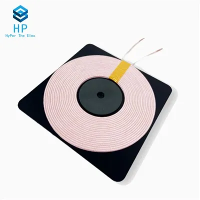

Hey there! As a supplier of hollow coils, I often get asked about the maximum current a hollow coil can carry. It's a super important question, especially for those who are using these coils in various applications. So, let's dive right into it and break down all the factors that play a role in determining this maximum current.
First off, what exactly is a hollow coil? Well, it's a coil that doesn't have a solid core inside. Instead, it's just the wire wound around an empty space. These coils are used in a ton of different things, like in electrical circuits, transformers, and even in some types of sensors.
One of the main factors that affects the maximum current a hollow coil can handle is the wire gauge. Simply put, the thicker the wire, the more current it can carry. This is because a thicker wire has less resistance. Resistance is like a roadblock for the current. The more resistance there is, the harder it is for the current to flow through the wire. And when the current has to work hard to get through, it generates heat. Too much heat can damage the coil, so we want to keep that in check.
Let's say you have two hollow coils. One is made with a thin wire, and the other with a thick wire. The thin - wire coil will have a higher resistance. So, if you try to pass a high current through it, it's going to heat up quickly. On the other hand, the thick - wire coil can handle more current because its resistance is lower.
Another thing to consider is the number of turns in the coil. The more turns a coil has, the higher its inductance. Inductance is a property that opposes changes in current. When you increase the current in a coil with high inductance, it takes some time for the current to reach its full value. This can limit the maximum current that the coil can carry, especially in applications where rapid changes in current are required.
The material of the wire also matters. Different metals have different electrical conductivities. Copper is a very popular choice for making hollow coils because it has high conductivity. That means it allows the current to flow easily, which is great for handling higher currents. Aluminum is another option, but it has lower conductivity compared to copper. So, if you're using an aluminum - wire coil, you might need a thicker wire to carry the same amount of current as a copper - wire coil.
The environment in which the coil is used is also crucial. If the coil is in a high - temperature environment, its ability to carry current is reduced. This is because the resistance of the wire increases with temperature. So, even if the coil can handle a certain current at room temperature, it might not be able to handle the same current in a hot environment.
Now, let's talk about some practical applications. In power supply circuits, hollow coils are used to filter out unwanted frequencies. The maximum current they need to carry depends on the power requirements of the circuit. For example, in a small electronic device like a smartphone charger, the current requirements are relatively low. So, a coil with a thinner wire and fewer turns might be sufficient.
On the other hand, in industrial applications like large motors or generators, the current requirements are much higher. In these cases, you'll need a coil with a thick wire and a large number of turns.


If you're looking for specific types of coils, we also offer Encapsulated Coil. These coils are protected by an encapsulation material, which can help improve their performance and durability. We also have DC Solenoid Coil and AC Solenoid Coil for different applications.
Calculating the maximum current of a hollow coil isn't always straightforward. You can use some basic electrical formulas, but in real - world scenarios, you also need to consider factors like heat dissipation. Heat dissipation is how the coil gets rid of the heat generated by the current. If the coil can't dissipate heat effectively, the temperature will keep rising, and that can lead to problems.
One way to improve heat dissipation is to use a coil with a larger surface area. You can do this by using a wider coil or by adding fins to the coil. Another option is to use a cooling system, like a fan or a heat sink.
When it comes to choosing the right hollow coil for your application, it's important to work with a reliable supplier. We have years of experience in manufacturing high - quality hollow coils. We can help you select the right wire gauge, number of turns, and other parameters based on your specific requirements.
If you're in the market for hollow coils and want to discuss your needs, don't hesitate to reach out. We're here to help you find the perfect coil for your project. Whether you're working on a small DIY project or a large - scale industrial application, we've got you covered.
In conclusion, the maximum current a hollow coil can carry depends on several factors, including wire gauge, number of turns, wire material, and the environment. By understanding these factors, you can make an informed decision when choosing a hollow coil for your application. And if you need any assistance, we're just a message away.