


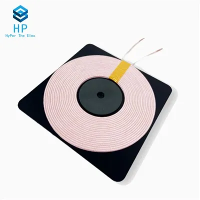
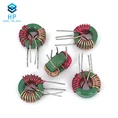

How does a filter inductor work?
As a trusted supplier of Filter Inductors, I've witnessed firsthand the critical role these components play in modern electronic systems. In this blog, I'll delve into the inner workings of filter inductors, explaining their principles, applications, and benefits.
Understanding the Basics of Inductors
Before we dive into filter inductors specifically, let's first understand the fundamental concept of an inductor. An inductor is a passive electronic component that stores energy in a magnetic field when an electric current flows through it. It consists of a coil of wire wound around a core, which can be made of various materials such as iron, ferrite, or air.
The key property of an inductor is its inductance, which is measured in henries (H). Inductance determines how much energy an inductor can store and how it responds to changes in current. According to Faraday's law of electromagnetic induction, when the current through an inductor changes, it induces an electromotive force (EMF) that opposes the change in current. This property is known as self - induction.
Mathematically, the induced EMF ((e)) in an inductor is given by the formula (e=-L\frac{di}{dt}), where (L) is the inductance and (\frac{di}{dt}) is the rate of change of current. The negative sign indicates that the induced EMF opposes the change in current.
How Filter Inductors Work
Filter inductors are a specialized type of inductor designed to filter out unwanted electrical noise or interference from a circuit. They work based on the principle of impedance. Impedance is the opposition that a circuit element offers to the flow of alternating current (AC). For an inductor, the impedance ((Z)) is given by the formula (Z = j\omega L), where (j) is the imaginary unit, (\omega) is the angular frequency of the AC signal ((\omega = 2\pi f), where (f) is the frequency), and (L) is the inductance.
As the frequency of the AC signal increases, the impedance of the inductor also increases. This means that an inductor will allow low - frequency signals to pass through relatively easily while presenting a high impedance to high - frequency signals. In a filter circuit, this property is used to separate different frequency components of a signal.
There are two main types of filter inductors: differential - mode inductors and common - mode inductors.
Differential - Mode Inductors: These inductors are used to filter differential - mode noise, which is the noise that exists between two signal lines. In a differential - mode filter circuit, the inductor is placed in series with the signal path. When a differential - mode noise signal tries to pass through the inductor, the high impedance of the inductor at the noise frequency blocks the noise, allowing only the desired signal to pass. For example, in a power supply circuit, differential - mode inductors can be used to filter out high - frequency ripple from the DC output. You can learn more about differential - mode inductors like BUCK Inductor and Coil Inductor on our website.
Common - Mode Inductors: Common - mode noise is the noise that appears on both signal lines with respect to a common reference, such as ground. Common - mode inductors are designed to have a high impedance to common - mode signals while having a low impedance to differential - mode signals. They are typically wound on a core in such a way that the magnetic fields generated by the differential - mode currents cancel each other out, while the magnetic fields generated by the common - mode currents add up. This results in a high impedance for common - mode noise, effectively filtering it out.
Applications of Filter Inductors
Filter inductors are used in a wide range of applications across various industries.
Power Supplies: In power supply circuits, filter inductors are used to smooth out the DC output by filtering out high - frequency ripple and noise. They help to provide a stable and clean power source for electronic devices. For example, in a switching power supply, filter inductors are essential for reducing electromagnetic interference (EMI) and improving the overall efficiency of the power supply.
Audio Systems: In audio systems, filter inductors are used to separate different frequency components of the audio signal. They can be used in crossover networks to direct low - frequency signals to the woofer and high - frequency signals to the tweeter. This ensures that each speaker operates within its optimal frequency range, resulting in better sound quality.
Telecommunication Systems: Filter inductors play a crucial role in telecommunication systems by filtering out unwanted signals and noise. They are used in radio frequency (RF) circuits to improve the signal - to - noise ratio and to prevent interference between different communication channels.
Automotive Electronics: In automotive electronics, filter inductors are used to protect sensitive electronic components from electrical noise generated by the vehicle's electrical system. They are used in applications such as engine control units (ECUs), infotainment systems, and lighting systems.
Benefits of Using Filter Inductors
The use of filter inductors offers several benefits in electronic systems.
Noise Reduction: One of the primary benefits of filter inductors is their ability to reduce electrical noise and interference. By filtering out unwanted signals, they improve the performance and reliability of electronic devices. This is especially important in sensitive applications such as medical equipment and aerospace electronics.
Improved Signal Quality: Filter inductors help to improve the signal quality by separating different frequency components of a signal. This results in a cleaner and more accurate signal, which is essential for applications such as audio and video systems.
EMI Suppression: Filter inductors are effective in suppressing electromagnetic interference (EMI). They help to meet the strict EMI regulations and standards, which are becoming increasingly important in modern electronic products.
Enhanced System Efficiency: By reducing noise and interference, filter inductors can improve the overall efficiency of electronic systems. This can lead to lower power consumption and longer device lifetimes.
Why Choose Our Filter Inductors
As a leading supplier of Filter Inductor, we are committed to providing high - quality products that meet the diverse needs of our customers. Our filter inductors are designed and manufactured using the latest technology and highest quality materials.


We offer a wide range of filter inductors with different inductance values, current ratings, and frequency responses to suit various applications. Our products undergo rigorous testing and quality control procedures to ensure their reliability and performance.
In addition to our high - quality products, we also provide excellent customer service. Our team of experts is always available to assist you with technical support, product selection, and application advice.
If you are in the market for filter inductors, we invite you to contact us to discuss your specific requirements. We are confident that we can provide you with the best solutions for your electronic systems. Whether you are a small - scale manufacturer or a large - scale industrial user, we are here to help you achieve your goals.
References
- Boylestad, R. L., & Nashelsky, L. (2012). Electronic Devices and Circuit Theory. Pearson.
- Sedra, A. S., & Smith, K. C. (2015). Microelectronic Circuits. Oxford University Press.
- Hayt, W. H., Kemmerly, J. E., & Durbin, S. M. (2012). Engineering Circuit Analysis. McGraw - Hill.