


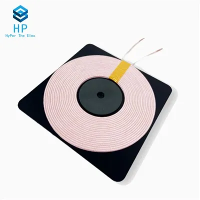


In the field of electronics, coil inductors play a crucial role in various applications, from power supplies to signal processing. As a Coil Inductor supplier, I've witnessed firsthand the importance of optimizing the coupling coefficient between two coil inductors. A high coupling coefficient can significantly enhance the performance of circuits, leading to more efficient power transfer, reduced interference, and improved overall functionality. In this blog post, I'll share some insights on how to increase the coupling coefficient between two coil inductors.
Understanding the Coupling Coefficient
Before delving into the methods of increasing the coupling coefficient, it's essential to understand what it represents. The coupling coefficient, denoted as (k), is a measure of the magnetic coupling between two inductors. It ranges from 0 to 1, where 0 indicates no coupling (the magnetic fields of the two inductors do not interact), and 1 represents perfect coupling (all the magnetic flux generated by one inductor links with the other).
Mathematically, the coupling coefficient is defined as:
[k=\frac{M}{\sqrt{L_1L_2}}]
where (M) is the mutual inductance between the two inductors, and (L_1) and (L_2) are their self - inductances.
Factors Affecting the Coupling Coefficient
Several factors influence the coupling coefficient between two coil inductors. Understanding these factors is the first step in optimizing the coupling.
Physical Proximity
The closer the two coil inductors are to each other, the greater the magnetic flux linkage between them, resulting in a higher coupling coefficient. When the coils are placed in close proximity, more of the magnetic field lines generated by one coil pass through the other coil, increasing the mutual inductance.
However, it's important to note that placing the coils too close may also lead to other issues, such as increased capacitance between the coils, which can cause unwanted resonance and signal distortion. Therefore, a balance needs to be struck between proximity and other electrical characteristics.
Coil Orientation
The orientation of the two coils relative to each other also has a significant impact on the coupling coefficient. When the axes of the two coils are aligned, the magnetic flux linkage is maximized, resulting in a higher coupling coefficient. For example, in a transformer, the primary and secondary coils are typically wound on the same core with their axes aligned to achieve high coupling.
On the other hand, if the coils are oriented perpendicular to each other, the magnetic flux linkage is minimized, and the coupling coefficient approaches zero.
Core Material
The use of a magnetic core can greatly enhance the coupling coefficient between two coil inductors. A magnetic core provides a low - reluctance path for the magnetic flux, allowing more of the magnetic field lines to be concentrated and linked between the two coils.
Materials such as ferrite and iron are commonly used as core materials due to their high magnetic permeability. Ferrite cores, in particular, are popular in high - frequency applications because of their low eddy current losses.
Methods to Increase the Coupling Coefficient
Using a Magnetic Core
As mentioned earlier, a magnetic core can significantly improve the coupling between two coil inductors. When designing inductors, choosing the right core material and shape is crucial. For example, toroidal cores are often used in applications where high coupling is required. Toroidal Inductors wound on a toroidal core have a closed magnetic path, which minimizes the leakage of magnetic flux and maximizes the coupling between the coils. You can learn more about Toroidal Inductors on our website.
Proper Coil Placement
Ensuring proper physical placement of the two coils is essential for maximizing the coupling coefficient. The coils should be placed as close as possible to each other while maintaining a safe distance to avoid unwanted electrical interactions. Additionally, the axes of the coils should be aligned to maximize the magnetic flux linkage.
In some cases, it may be necessary to use mechanical fixtures or enclosures to hold the coils in the correct position and orientation.
Optimizing Coil Design
The design of the coils themselves can also affect the coupling coefficient. Increasing the number of turns in the coils can increase the self - inductance and the mutual inductance, leading to a higher coupling coefficient. However, increasing the number of turns also increases the resistance of the coils, which can affect the efficiency of the circuit.
Another design consideration is the shape of the coils. Coils with a larger cross - sectional area can capture more magnetic flux, resulting in a higher coupling coefficient.
Practical Applications
The ability to increase the coupling coefficient between two coil inductors has numerous practical applications in the electronics industry.


Power Transfer
In power supplies, such as BUCK Inductor - based converters, a high coupling coefficient between the input and output inductors can improve the efficiency of power transfer. By minimizing the leakage of magnetic flux, more of the energy stored in the magnetic field can be transferred from the input to the output, reducing power losses and improving the overall performance of the converter.
Signal Coupling
In communication systems, high - coupling inductors are used to transfer signals efficiently between different stages of a circuit. For example, in a radio frequency (RF) amplifier, a high - coupling transformer can be used to match the impedance between the input and output stages, improving the gain and linearity of the amplifier.
Conclusion
Increasing the coupling coefficient between two coil inductors is a critical aspect of designing efficient and high - performance electronic circuits. By understanding the factors that affect the coupling coefficient and implementing the appropriate methods, such as using a magnetic core, proper coil placement, and optimizing coil design, it's possible to achieve a high coupling coefficient and improve the overall performance of the circuit.
As a Coil Inductor supplier, we are committed to providing high - quality inductors that meet the specific requirements of our customers. If you're interested in learning more about our products or have any questions regarding the coupling coefficient of our inductors, please feel free to contact us for a purchase consultation. We look forward to working with you to optimize your electronic designs.
References
- Hayt, W. H., & Kemmerly, J. E. (2001). Engineering Circuit Analysis. McGraw - Hill.
- Alexander, C. K., & Sadiku, M. N. O. (2009). Fundamentals of Electric Circuits. McGraw - Hill.
- Grover, F. W. (1946). Inductance Calculations: Working Formulas and Tables. Dover Publications.