


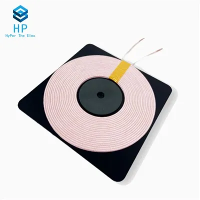
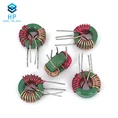

Hey there! As a supplier of toroidal inductors, I'm super stoked to share all the ins and outs of these nifty components with you. Toroidal inductors are pretty cool, and understanding their specifications can make a huge difference in your electronic projects. So, let's dive right in!
Basic Concepts
First off, what's an inductor anyway? Well, an inductor is a passive electronic component that stores energy in a magnetic field when an electric current flows through it. A toroidal inductor is a special type of inductor where the coil is wound around a doughnut - shaped (toroidal) core. This unique shape offers some great advantages over other inductor designs.
Key Specifications
Inductance
Inductance is probably the most important spec when it comes to inductors. It's measured in henries (H), but you'll often see it in millihenries (mH), microhenries (μH), or even nanohenries (nH). The inductance of a toroidal inductor depends on a few factors, like the number of turns in the coil, the permeability of the core material, and the cross - sectional area of the core.
A higher inductance value means the inductor can store more energy in its magnetic field. For example, if you're working on a power supply circuit, you might need a toroidal inductor with a relatively high inductance to smooth out the current flow. On the other hand, in high - frequency applications, you might use an inductor with a lower inductance value. You can check out our Coil Inductor page for more details on different inductance options.
DC Resistance (DCR)
DC resistance is the resistance of the inductor's coil to direct current. It's measured in ohms (Ω). A lower DCR is generally better because it means less power is wasted as heat when current flows through the inductor. When you're designing a circuit, you want to keep an eye on the DCR to make sure your inductor isn't going to cause unnecessary power losses.
For instance, in a low - power audio amplifier, a toroidal inductor with a low DCR can help improve the overall efficiency of the amplifier. Our BUCK Inductor products are designed with low DCR in mind to ensure optimal performance in various applications.
Current Rating
The current rating of a toroidal inductor is the maximum amount of current it can handle without overheating or saturating. Saturation occurs when the magnetic core of the inductor can no longer store any more magnetic flux, and the inductance value starts to drop.
If you exceed the current rating, the inductor can get really hot, which not only reduces its performance but can also damage the component and other parts of your circuit. So, it's crucial to choose an inductor with a current rating that's appropriate for your application. For power - hungry circuits, like those in electric vehicles or high - power LED drivers, you'll need a toroidal inductor with a high current rating.
Quality Factor (Q)
The quality factor, or Q, is a measure of the efficiency of an inductor. It's defined as the ratio of the reactance of the inductor to its resistance at a given frequency. A higher Q value means the inductor has less energy loss and is more efficient.
In high - frequency applications, such as radio frequency (RF) circuits, a toroidal inductor with a high Q value can help improve the selectivity and performance of the circuit. You can think of it like a well - tuned musical instrument - the higher the Q, the better the "sound" of your circuit.
Self - Resonant Frequency (SRF)
Every inductor has a self - resonant frequency, which is the frequency at which the inductor's inductive reactance equals its capacitive reactance. At this frequency, the inductor acts like a resonant circuit, and its impedance reaches a maximum.
Above the SRF, the inductor starts to behave more like a capacitor, and its inductance properties are no longer dominant. So, if you're using a toroidal inductor in a high - frequency application, you need to make sure the operating frequency is well below the SRF to ensure it functions as an inductor. Our Filter Inductor products are carefully designed to have appropriate SRF values for different frequency ranges.
Core Materials
The core material of a toroidal inductor plays a big role in determining its specifications. Here are some common core materials:
Ferrite
Ferrite cores are widely used in toroidal inductors because they have high magnetic permeability, which means they can store a lot of magnetic energy. They also have low eddy - current losses, making them suitable for high - frequency applications. However, ferrite cores can saturate at relatively low currents, so they're not ideal for high - power applications.
Iron Powder
Iron powder cores are made by compressing iron powder particles together. They have a more linear magnetic characteristic compared to ferrite cores, which means they can handle higher currents without saturating. They're often used in power supply circuits and DC - DC converters.
Molybdenum Permalloy Powder (MPP)
MPP cores offer a good balance between high inductance, low core losses, and high current handling capabilities. They're more expensive than ferrite and iron powder cores but are worth it for applications that require high performance, such as precision filters and RF circuits.
Applications
Toroidal inductors are used in a wide variety of applications, thanks to their unique specifications. Here are some examples:
Power Supplies
In power supplies, toroidal inductors are used to filter out ripple current and smooth the output voltage. Their high inductance and low DCR make them ideal for this purpose. Whether it's a switch - mode power supply or a linear power supply, toroidal inductors can help improve the stability and efficiency of the power supply.
Audio Equipment
In audio amplifiers and speakers, toroidal inductors can be used to filter out unwanted frequencies and improve the sound quality. Their low distortion and high Q values make them a popular choice among audio enthusiasts.
RF Circuits
In radio frequency circuits, toroidal inductors are used in filters, oscillators, and impedance - matching networks. Their high self - resonant frequency and low parasitic capacitance make them suitable for high - frequency operation.
Why Choose Our Toroidal Inductors?
As a supplier, we take pride in offering high - quality toroidal inductors with precise specifications. Our team of experts carefully selects the core materials and designs the coils to ensure optimal performance in different applications. We conduct rigorous testing on all our products to make sure they meet the highest standards.
Whether you need a toroidal inductor for a small DIY project or a large - scale industrial application, we've got you covered. Our wide range of products includes Coil Inductor, BUCK Inductor, and Filter Inductor, each tailored to specific requirements.


Let's Talk!
If you're interested in our toroidal inductors or have any questions about their specifications, we'd love to hear from you. Contact us to start a conversation about your project needs. We can help you choose the right inductor with the perfect specifications for your application.
References
- "The Art of Electronics" by Paul Horowitz and Winfield Hill
- "Electronic Devices and Circuit Theory" by Robert L. Boylestad and Louis Nashelsky