


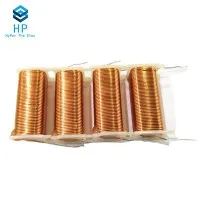

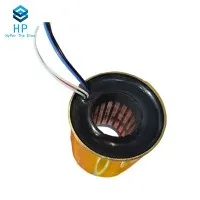

As a supplier of Resonant Coils, I've witnessed firsthand the critical role these components play in a wide range of electronic applications. The quality factor (Q-factor) of a resonant coil is a key parameter that significantly impacts its performance. In this blog, I'll explore the various factors that affect the Q-factor of a resonant coil, drawing on my experiences in the industry.
Understanding the Quality Factor
Before delving into the factors that influence the Q-factor, it's essential to understand what it represents. The Q-factor of a resonant coil is a measure of its efficiency in storing and transferring energy. A higher Q-factor indicates a lower rate of energy loss and a more efficient coil. It is defined as the ratio of the reactance of the coil to its resistance at resonance. Mathematically, it can be expressed as:
[ Q = \frac{\omega L}{R} ]
where ( \omega ) is the angular frequency, ( L ) is the inductance of the coil, and ( R ) is the resistance of the coil.
Material Properties
The choice of materials used in the construction of a resonant coil has a profound impact on its Q-factor.
Conductive Material
The conductive material of the coil wire is a crucial factor. Copper is a popular choice due to its high electrical conductivity and relatively low cost. Silver, on the other hand, has even higher conductivity than copper, which can result in a lower resistance and a higher Q-factor. However, the high cost of silver often makes it less practical for mass production.


The purity of the conductive material also matters. Impurities in the metal can increase the resistance, reducing the Q-factor. For example, copper with a higher percentage of impurities will have a higher resistance compared to high-purity copper, leading to a lower Q-factor.
Core Material
The core material of the coil can significantly affect its inductance and resistance, thereby influencing the Q-factor. There are different types of core materials, each with its own characteristics.
Air cores are often used when a low-loss and high Q-factor are required. Since air has a very low magnetic permeability, there is no magnetic core loss, which helps to maintain a high Q-factor. However, air-core coils typically have a lower inductance compared to coils with magnetic cores.
Ferrite cores are commonly used to increase the inductance of the coil. Ferrite materials have a high magnetic permeability, which allows for a higher inductance value in a smaller physical size. However, ferrite cores can introduce losses due to hysteresis and eddy currents, especially at high frequencies. The choice of ferrite material and its composition can be optimized to minimize these losses and improve the Q-factor.
Powdered iron cores are another option. They offer a compromise between air cores and ferrite cores. Powdered iron cores have a lower magnetic permeability compared to ferrite cores but can provide better high-frequency performance with lower losses.
Coil Geometry
The physical geometry of the coil also plays a significant role in determining its Q-factor.
Number of Turns
The number of turns in the coil affects both its inductance and resistance. Increasing the number of turns generally increases the inductance of the coil. However, it also increases the length of the wire, which in turn increases the resistance. The relationship between the number of turns and the Q-factor is not linear. There is an optimal number of turns that maximizes the Q-factor for a given set of design parameters.
Coil Diameter
The diameter of the coil can impact its Q-factor. A larger diameter coil generally has a lower resistance per turn compared to a smaller diameter coil. This is because the length of the wire per turn is shorter for a larger diameter coil. As a result, a larger diameter coil can potentially have a higher Q-factor. However, a larger diameter coil may also require more space and may not be suitable for applications with size constraints.
Coil Pitch
The pitch, or the distance between adjacent turns, can affect the Q-factor. A smaller pitch can increase the capacitance between turns, which can lead to a decrease in the Q-factor, especially at high frequencies. On the other hand, a larger pitch can reduce the capacitance but may also increase the overall size of the coil. Finding the right balance in coil pitch is important to optimize the Q-factor.
Frequency of Operation
The frequency at which the resonant coil operates has a significant impact on its Q-factor.
At low frequencies, the resistance of the coil is mainly determined by the DC resistance of the wire. As the frequency increases, the skin effect becomes more pronounced. The skin effect causes the current to flow mainly near the surface of the wire, effectively increasing the resistance. This increase in resistance leads to a decrease in the Q-factor at high frequencies.
To mitigate the impact of the skin effect, special wire designs such as Litz wire can be used. Litz wire consists of multiple insulated strands of wire that are woven together in a specific pattern. This design helps to reduce the skin effect and maintain a relatively high Q-factor at high frequencies.
External Factors
There are also external factors that can affect the Q-factor of a resonant coil.
Temperature
Temperature can have a significant impact on the resistance of the coil wire. As the temperature increases, the resistance of most conductive materials also increases. This increase in resistance can lead to a decrease in the Q-factor. Therefore, it is important to consider the operating temperature range when designing a resonant coil. In some applications, temperature compensation techniques may be required to maintain a stable Q-factor over a wide temperature range.
Surrounding Environment
The surrounding environment can also affect the Q-factor. For example, the presence of nearby conductive or magnetic materials can introduce additional losses due to electromagnetic coupling. This can lead to a decrease in the Q-factor. To minimize the impact of the surrounding environment, proper shielding and isolation techniques can be employed.
Conclusion
In conclusion, the Q-factor of a resonant coil is influenced by a variety of factors, including material properties, coil geometry, frequency of operation, and external factors. As a supplier of Resonant Coils, we understand the importance of optimizing these factors to provide high-quality coils with excellent performance. Whether you need a Trap Coil for a specific filtering application or an Antenna Coil for wireless communication, we can work with you to design and manufacture coils that meet your requirements.
If you're interested in learning more about our resonant coils or would like to discuss a specific project, please don't hesitate to reach out. We're here to help you find the best solutions for your applications.
References
- Paul, Clayton R. "Electromagnetic Compatibility for Power Electronics: Principles and Applications." John Wiley & Sons, 2007.
- Hayt, William H., and Jack E. Kemmerly. "Engineering Circuit Analysis." McGraw-Hill Education, 2012.
- Kraus, John D., and Ronald J. Marhefka. "Antennas for All Applications." McGraw-Hill Education, 2001.