


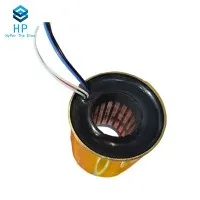
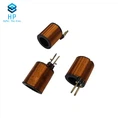
Hey there! As a supplier of Antenna Coils, I often get asked about the permeability of the core in an Antenna Coil. It's a super important topic that can really impact how well an antenna coil works. So, let's dive right in and break it down.
First off, what exactly is permeability? In simple terms, permeability is a measure of how easily a magnetic field can pass through a material. You can think of it like how easily water can flow through a pipe. If the pipe is wide and smooth, water can flow through it easily. Similarly, if a material has high permeability, a magnetic field can pass through it easily.
In an Antenna Coil, the core plays a crucial role. The core is the material that the coil is wrapped around. It can be made of different materials, and each material has its own permeability. The permeability of the core affects the inductance of the coil. Inductance is basically the ability of a coil to store energy in a magnetic field when an electric current flows through it.
Let's talk about some common core materials and their permeabilities. One of the most widely used materials is ferrite. Ferrite has a relatively high permeability, which means it can enhance the magnetic field of the coil. This is great for antenna coils because a stronger magnetic field can improve the coil's performance, such as increasing its sensitivity and range.
Another material is air. Air has a very low permeability, almost close to that of a vacuum. Antenna coils with an air core are often used in applications where a low inductance and high Q factor (a measure of the efficiency of the coil) are required. They're also lighter and more compact, which can be an advantage in some situations.
Now, you might be wondering how the permeability of the core affects the antenna coil's performance. Well, as I mentioned earlier, it mainly impacts the inductance. A higher permeability core will result in a higher inductance value for the coil. This can be useful in applications where you need to tune the antenna to a specific frequency. For example, in radio communication, you want the antenna to resonate at a particular frequency to receive or transmit signals effectively. By choosing a core material with the right permeability, you can adjust the inductance of the coil and fine - tune the antenna's frequency response.
Let's take a look at some different types of antenna coils and how core permeability comes into play. There's the Oscillating Coil. These coils are used in circuits that generate oscillating electrical signals. The permeability of the core in an oscillating coil can affect the frequency and stability of the oscillations. A core with a well - controlled permeability can help ensure that the oscillations occur at the desired frequency and remain stable over time.
Then there's the Resonant Coil. Resonant coils are designed to resonate at a specific frequency. The permeability of the core is a key factor in determining this resonant frequency. If the permeability is too high or too low, the coil may not resonate at the intended frequency, which can lead to poor performance in applications like wireless power transfer or radio frequency identification (RFID) systems.
And don't forget about the Choke Coil. Choke coils are used to block high - frequency signals while allowing low - frequency or direct current to pass through. The permeability of the core in a choke coil affects its ability to block high - frequency signals. A core with a high permeability can effectively concentrate the magnetic field and increase the coil's impedance at high frequencies, making it a better choke.
When it comes to choosing the right core material for an antenna coil, there are a few things to consider. First, you need to think about the application. If you're working on a high - frequency application, you might want to go for a core with a lower permeability to avoid losses due to eddy currents (currents induced in the core by the changing magnetic field). On the other hand, if you need a high - inductance coil for a low - frequency application, a high - permeability core like ferrite would be a good choice.
Cost is also an important factor. Some core materials, like certain types of ferrite, can be more expensive than others. You need to balance the performance requirements with the budget.
Size and weight can matter too. In applications where space and weight are limited, you might prefer an air - core coil or a coil with a lightweight core material.
As a supplier of Antenna Coils, I understand the importance of getting the core permeability right. That's why we offer a wide range of antenna coils with different core materials and permeabilities to meet the diverse needs of our customers. Whether you're in the telecommunications industry, the automotive sector, or any other field that requires high - quality antenna coils, we've got you covered.


If you're interested in learning more about our Antenna Coils or have specific requirements for your project, I'd love to hear from you. We can work together to find the perfect coil with the right core permeability for your application. Just reach out to us, and we'll start the conversation.
In conclusion, the permeability of the core in an Antenna Coil is a critical factor that can significantly impact the coil's performance. By understanding how different core materials and their permeabilities work, you can make informed decisions when choosing an antenna coil for your project. So, don't hesitate to get in touch if you have any questions or need help with your antenna coil needs.
References
- Electromagnetics textbooks
- Industry reports on antenna coil technology