


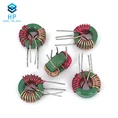


As a supplier of Encapsulated Coils, I often get asked about the power rating of these nifty little components. So, let's dive right in and break it down in a way that's easy to understand.
First off, what exactly is an Encapsulated Coil? Well, it's a coil that's enclosed in a protective material, which can be anything from plastic to epoxy resin. This encapsulation serves a few important purposes. It protects the coil from physical damage, environmental factors like moisture and dust, and can also help with electrical insulation.
Now, onto the power rating. The power rating of an Encapsulated Coil refers to the amount of electrical power that the coil can handle safely and efficiently. It's usually measured in watts (W), and it's a crucial specification because it determines how the coil will perform in a given application.
There are a few factors that influence the power rating of an Encapsulated Coil. One of the main ones is the wire gauge used in the coil. Thicker wires generally have lower resistance, which means they can handle more current without overheating. For example, if you have a coil made with a thick wire, it can typically handle a higher power rating compared to a coil with a thinner wire.
Another factor is the number of turns in the coil. More turns generally mean higher inductance, which can affect the power consumption and the overall performance of the coil. When the number of turns increases, the coil's ability to store magnetic energy also goes up, but it can also lead to higher resistance and potentially lower power efficiency if not designed properly.
The type of core material used in the coil also plays a role. Some core materials, like iron or ferrite, can enhance the magnetic field generated by the coil, which can in turn affect the power requirements. For instance, a coil with a high - permeability core material might be able to achieve a certain magnetic effect with less power compared to a coil with a lower - permeability core.
Let's talk about the different types of applications and how the power rating matters. We have DC solenoid coils DC Solenoid Coil. These are used in a wide range of applications, from automotive starters to industrial automation systems. In a DC solenoid coil, the power rating determines how quickly it can generate the magnetic field needed to move the solenoid plunger. If the power rating is too low, the solenoid might not work properly or might take a long time to activate. On the other hand, if it's too high, it can cause overheating and potentially damage the coil.
AC solenoid coils AC Solenoid Coil have their own set of considerations. The alternating current in these coils creates a constantly changing magnetic field. The power rating here is important for ensuring that the coil can handle the fluctuations in current and voltage. If the power rating is not appropriate, the coil might experience issues like humming, overheating, or even premature failure.
Solenoid valve coils Solenoid Valve Coil are another important application. These coils are used to control the flow of fluids in various systems, such as in plumbing, chemical processing, and HVAC systems. The power rating of a solenoid valve coil determines how well it can open and close the valve. A coil with an incorrect power rating might not be able to fully open the valve, leading to reduced flow or might not close it properly, causing leaks.
When it comes to selecting the right power rating for an Encapsulated Coil, it's all about matching the coil to the specific requirements of the application. You need to consider factors like the operating voltage, the desired magnetic force, and the duty cycle. The duty cycle refers to the percentage of time that the coil is energized in a given cycle. For example, if a coil has a 50% duty cycle, it means it's energized for half of the time and off for the other half. A coil with a high - duty cycle might need a higher power rating to handle the continuous operation without overheating.


As a supplier, we have a team of experts who can help you determine the right power rating for your Encapsulated Coil. We understand that every application is unique, and we're committed to providing you with the best - fitting solution. Whether you're working on a small DIY project or a large - scale industrial application, our coils are designed to meet the highest standards of quality and performance.
If you're in the market for Encapsulated Coils with the right power rating for your needs, we'd love to have a chat with you. We can discuss your specific requirements, answer any questions you might have, and provide you with a quote. Reach out to us to start the conversation about how our Encapsulated Coils can make a difference in your project.
References
- Electrical Engineering Fundamentals textbooks
- Manufacturer's datasheets for Encapsulated Coils