




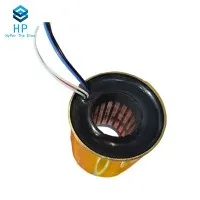
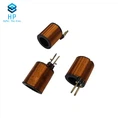
Hey there! As a supplier of encapsulated coils, I often get asked about the Q-factor of these coils. It's a pretty important concept in the world of electronics and electrical engineering, so I thought I'd take the time to break it down for you.


What's the Deal with the Q - factor?
The Q-factor, or quality factor, is essentially a measure of how 'good' an inductor (like our encapsulated coils) is at storing and transferring energy. It's a dimensionless number that gives us an idea of the efficiency and performance of the coil. In simple terms, a higher Q-factor means the coil is more efficient in storing and releasing energy with less loss.
You can think of it like a well - tuned musical instrument. When you pluck a string on a high - quality guitar, the sound rings out clearly and for a long time because the guitar is efficient at storing and transferring the energy from your pluck into sound. Similarly, a coil with a high Q - factor can store and transfer electrical energy more effectively.
How Is It Calculated?
The Q - factor of a coil is calculated using the formula (Q = 2\pi fL/R), where (f) is the frequency of the alternating current (AC) passing through the coil, (L) is the inductance of the coil, and (R) is the resistance of the coil.
Let's break this down a bit. The inductance (L) is a measure of the coil's ability to store energy in a magnetic field. The higher the inductance, the more energy the coil can store. The resistance (R) represents the losses in the coil. These losses can come from things like the resistance of the wire used to make the coil and any core losses if the coil has a magnetic core.
The frequency (f) is important because the behavior of the coil changes with the frequency of the current passing through it. At higher frequencies, the effects of inductance and resistance can be quite different compared to lower frequencies.
Why Does the Q - factor Matter?
For us as an encapsulated coil supplier, the Q - factor matters a lot. It directly impacts the performance of the coils in various applications.
In Tuned Circuits
In tuned circuits, like those used in radio receivers and transmitters, a high Q - factor is crucial. These circuits are designed to resonate at a specific frequency. A coil with a high Q - factor will have a narrow resonance peak, which means it can be very selective about the frequencies it responds to. This helps in filtering out unwanted frequencies and improving the overall signal quality.
For example, if you're listening to a radio station, a tuned circuit with a high - Q coil can better pick out the specific frequency of that station and reject other nearby frequencies. This results in clearer reception and less interference.
In Power Transfer
In applications where power transfer is important, such as in transformers and inductive charging systems, a high Q - factor can improve the efficiency of power transfer. A coil with a high Q - factor loses less energy as heat, so more of the input power can be transferred to the load.
This is especially important in modern electronics, where energy efficiency is a top priority. By using coils with a high Q - factor, we can help our customers reduce power consumption and extend the battery life of their devices.
Factors Affecting the Q - factor of Encapsulated Coils
There are several factors that can affect the Q - factor of our encapsulated coils.
Coil Design
The design of the coil plays a big role. The number of turns in the coil, the diameter of the wire, and the shape of the coil all impact the inductance and resistance, and thus the Q - factor. For example, using a thicker wire can reduce the resistance of the coil, which in turn can increase the Q - factor.
Encapsulation Material
The material used to encapsulate the coil can also have an effect. Some encapsulation materials may have dielectric losses, which can increase the overall losses in the coil and lower the Q - factor. We carefully select the encapsulation materials to minimize these losses and ensure the best possible performance of our coils.
Frequency
As mentioned earlier, the frequency of the current passing through the coil affects the Q - factor. At very high frequencies, the skin effect and proximity effect can become significant. The skin effect causes the current to flow mainly on the surface of the wire, increasing the effective resistance of the wire. The proximity effect occurs when the magnetic fields of adjacent turns in the coil interact, also increasing the resistance. These effects can lower the Q - factor at high frequencies.
Our Encapsulated Coils and the Q - factor
At our company, we take great care to optimize the Q - factor of our encapsulated coils. We use advanced design techniques and high - quality materials to ensure that our coils have the best possible performance.
We offer a wide range of encapsulated coils, including Solenoid Valve Coil, Hollow Coil, and AC Solenoid Coil. Each of these coils is designed to meet specific requirements and applications, and we can customize the Q - factor based on our customers' needs.
Whether you need a coil with a high Q - factor for a precision tuned circuit or a coil with a moderate Q - factor for a general - purpose application, we've got you covered. Our team of experts can work with you to understand your requirements and recommend the best coil for your project.
Conclusion
The Q - factor is an important parameter when it comes to encapsulated coils. It can greatly impact the performance and efficiency of the coils in various applications. As a supplier, we're committed to providing high - quality coils with optimized Q - factors to meet the needs of our customers.
If you're in the market for encapsulated coils or have any questions about the Q - factor or our products, don't hesitate to reach out. We'd love to have a chat with you, learn about your project, and help you find the perfect coil solution. Let's work together to make your next project a success!
References
- "Electric Circuits" by James W. Nilsson and Susan A. Riedel
- "Electromagnetics for Engineers" by Nathan Ida