


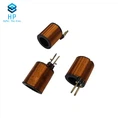

In the realm of Radio - Frequency Identification (RFID) systems, the Antenna Coil plays a pivotal and multi - faceted role. As an Antenna Coil supplier, I have witnessed firsthand how these components are the unsung heroes in making RFID technology function effectively.
Understanding the Basics of RFID Systems
Before delving into the role of the Antenna Coil, it is essential to understand the fundamental working principle of RFID systems. An RFID system typically consists of three main components: an RFID tag, an RFID reader, and an Antenna Coil. The RFID tag is a small device that contains a microchip and an antenna. It stores data such as product information, identification numbers, or other relevant details. The RFID reader is responsible for reading the data stored on the tag.
The basic operation involves the reader sending out radio - frequency signals. When an RFID tag comes within the range of these signals, the tag's antenna picks up the energy from the signals. This energy powers the tag's microchip, which then sends back a response signal containing the stored data. The reader receives this response and processes the information.
The Central Role of the Antenna Coil
Signal Transmission and Reception
The Antenna Coil serves as the interface between the RFID reader and the RFID tag. It is responsible for transmitting the radio - frequency signals from the reader into the surrounding environment. These signals are in the form of an alternating electromagnetic field. When an RFID tag enters this field, the tag's antenna can couple with the field and extract energy from it.
On the receiving end, the Antenna Coil captures the response signals sent by the RFID tags. It then transfers these signals back to the RFID reader for further processing. The efficiency of signal reception is crucial for an RFID system to work accurately. A well - designed Antenna Coil can enhance the signal - to - noise ratio, ensuring that the reader can distinguish the tag's response from background interference.
Energy Transfer
One of the most critical functions of the Antenna Coil is energy transfer. Passive RFID tags, which are the most commonly used type, do not have their own power source. Instead, they rely on the energy received from the electromagnetic field generated by the Antenna Coil of the RFID reader.
The Antenna Coil creates an oscillating magnetic field. When a passive RFID tag enters this field, the tag's antenna, which is also typically a coil, experiences a change in magnetic flux. According to Faraday's law of electromagnetic induction, this change in magnetic flux induces an electromotive force (EMF) in the tag's coil. This induced EMF generates an electric current that powers the tag's microchip, allowing it to send back a response signal.
Determining the Read Range
The read range of an RFID system, which is the maximum distance at which the reader can accurately read the tag, is largely determined by the Antenna Coil. Several factors related to the Antenna Coil influence the read range, such as its size, shape, number of turns, and the material used.
A larger Antenna Coil generally produces a stronger and more extensive electromagnetic field, which can increase the read range. However, larger coils may also be more expensive and less practical in some applications. The number of turns in the coil also affects the magnetic field strength. More turns typically result in a stronger field, but this also increases the coil's resistance and may require more power to operate.
Types of Antenna Coils in RFID Systems
Resonant Coil
The Resonant Coil is a type of Antenna Coil that is designed to resonate at a specific frequency. Resonance occurs when the inductive reactance of the coil is equal to the capacitive reactance in the circuit. At resonance, the impedance of the coil is minimized, and the current flowing through the coil is maximized.
In an RFID system, using a Resonant Coil can significantly improve the efficiency of signal transmission and reception. It allows the Antenna Coil to operate at its optimal frequency, which is usually the same as the operating frequency of the RFID system. This ensures that the maximum amount of energy is transferred between the reader and the tags, resulting in a higher read range and more reliable performance.
Oscillating Coil
The Oscillating Coil is another important type of Antenna Coil in RFID systems. It is used to create an oscillating magnetic field, which is essential for powering passive RFID tags and communicating with them.
The oscillating coil generates an alternating current, which in turn produces an alternating magnetic field. This magnetic field varies in strength and direction over time, creating a dynamic environment in which the RFID tags can interact. The frequency of the oscillation is carefully controlled to match the requirements of the RFID system.
Design Considerations for Antenna Coils in RFID Systems
Material Selection
The choice of material for the Antenna Coil is critical. Copper is a commonly used material due to its high electrical conductivity. High - conductivity materials reduce the resistance of the coil, minimizing power losses and improving the efficiency of the Antenna Coil.
In addition to the conductor material, the insulation material also plays an important role. It should have good dielectric properties to prevent electrical leakage and ensure the stability of the coil's performance.
Size and Shape
The size and shape of the Antenna Coil are determined by the specific application requirements. For example, in applications where space is limited, such as in small handheld RFID readers, a compact and low - profile Antenna Coil may be required.
Different shapes, such as circular, rectangular, or spiral, can be used depending on the magnetic field distribution needed. A circular coil, for instance, may provide a more uniform magnetic field around its center, while a rectangular coil may be more suitable for applications where a specific directional field is required.
Environmental Factors
Environmental factors such as temperature, humidity, and electromagnetic interference can affect the performance of the Antenna Coil. In high - temperature environments, the resistance of the coil may increase, leading to power losses and reduced efficiency. Humidity can cause corrosion of the coil's conductor, which can also degrade its performance over time.
To mitigate these effects, the Antenna Coil may need to be protected with appropriate coatings or enclosures. Additionally, electromagnetic shielding can be used to reduce the impact of external electromagnetic interference on the coil's performance.
Our Offerings as an Antenna Coil Supplier
As an Antenna Coil supplier, we understand the importance of providing high - quality products that meet the diverse needs of our customers. We offer a wide range of Antenna Coils with different specifications, including different sizes, shapes, and resonant frequencies.
Our Antenna Coils are designed and manufactured using advanced technology and high - quality materials. We have a team of experienced engineers who can work closely with customers to develop customized Antenna Coils for specific applications. Whether it is for a large - scale logistics RFID system or a small - scale access control system, we can provide the right solution.


Conclusion
The Antenna Coil is an indispensable component in RFID systems. Its role in signal transmission, energy transfer, and determining the read range is crucial for the proper functioning of the entire system. As technology continues to advance, the demand for more efficient and reliable Antenna Coils will only increase.
If you are in need of high - quality Antenna Coils for your RFID applications, please feel free to contact us. We are committed to providing you with the best products and services, and look forward to discussing your requirements and finding the perfect Antenna Coil solutions for you.
References
- Dobkin, David. "The RF in RFID: Passive UHF Radio Frequency Identification in Practice". Morgan Kaufmann, 2008.
- Schwieger, Robert. "RFID Handbook: Fundamentals and Applications in Contactless Smart Cards, Radio Frequency Identification and Near - Field Communication". Wiley, 2011.