


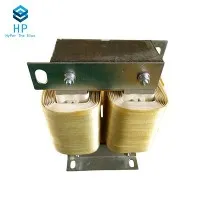

As a supplier of AC solenoid coils, I often encounter inquiries about the technical aspects of these components, especially regarding self - inductance. In this blog, I'll delve into what self - inductance is in the context of an AC solenoid coil, its significance, and how it impacts the performance of the coil.
Understanding Self - Inductance
Self - inductance is a fundamental property of an electrical circuit, specifically a coil, that describes its ability to oppose changes in the current flowing through it. When the current in a coil changes, it generates a magnetic field around the coil. According to Faraday's law of electromagnetic induction, this changing magnetic field then induces an electromotive force (EMF) in the same coil. This induced EMF is called the self - induced EMF, and the phenomenon is known as self - inductance.
Mathematically, self - inductance (L) is defined by the equation (\epsilon=-L\frac{di}{dt}), where (\epsilon) is the self - induced EMF, (\frac{di}{dt}) is the rate of change of current, and the negative sign indicates that the induced EMF opposes the change in current (Lenz's law). The unit of self - inductance is the henry (H).
Self - Inductance in an AC Solenoid Coil
A solenoid is a coil of wire wound in a helical shape. When an alternating current (AC) is passed through an AC solenoid coil, the current is constantly changing. As a result, the magnetic field produced by the coil also changes continuously. This changing magnetic field induces a self - induced EMF in the coil, which resists the change in current.
The self - inductance of a solenoid coil depends on several factors:
- Number of turns ((N)): The self - inductance is directly proportional to the square of the number of turns in the coil. That is, (L\propto N^{2}). A solenoid with more turns will have a higher self - inductance because more turns mean a stronger magnetic field for a given current, and thus a greater induced EMF when the current changes.
- Cross - sectional area ((A)): Self - inductance is directly proportional to the cross - sectional area of the solenoid. A larger cross - sectional area allows for a greater magnetic flux through the coil, leading to a higher self - inductance. So, (L\propto A).
- Length ((l)): Self - inductance is inversely proportional to the length of the solenoid. A shorter solenoid will have a higher self - inductance because the magnetic field lines are more concentrated, resulting in a larger induced EMF. So, (L\propto\frac{1}{l}).
- Permeability ((\mu)) of the core material: If the solenoid has a core made of a magnetic material (such as iron), the self - inductance will be significantly increased. The permeability (\mu) of the core material is a measure of how easily the material can be magnetized. The self - inductance is directly proportional to the permeability of the core material, (L\propto\mu).
The formula for the self - inductance of a solenoid with a uniform cross - section and a core of permeability (\mu) is given by (L = \frac{\mu N^{2}A}{l}).


Significance of Self - Inductance in AC Solenoid Coils
- Impedance in AC circuits: In an AC circuit, the self - inductance of a solenoid coil contributes to the impedance ((Z)) of the circuit. The impedance of an inductor (solenoid coil) in an AC circuit is given by (Z_{L}=\omega L), where (\omega = 2\pi f) is the angular frequency of the AC signal and (f) is the frequency. As the frequency of the AC current increases, the impedance of the solenoid coil also increases. This means that the coil will allow less current to flow at higher frequencies, acting as a frequency - dependent resistor.
- Energy storage: A solenoid coil with self - inductance can store energy in its magnetic field. The energy stored in an inductor is given by (U=\frac{1}{2}Li^{2}), where (i) is the current flowing through the coil. When the current in the coil changes, the energy stored in the magnetic field also changes. This energy storage property is important in applications such as electromagnetic relays and motors, where the magnetic field energy can be used to perform mechanical work.
- Phase shift: In an AC circuit containing an inductor, the current lags behind the voltage by 90 degrees. This phase shift is a result of the self - inductance of the coil. The self - induced EMF opposes the change in current, causing the current to reach its maximum value after the voltage has reached its maximum value. This phase relationship is crucial in the design of AC circuits, especially in power systems and electronic devices.
Applications of AC Solenoid Coils Based on Self - Inductance
- Solenoid valves: Solenoid Valve Coil are widely used in fluid control systems. The self - inductance of the coil in a solenoid valve affects its response time and power consumption. A coil with a higher self - inductance may have a slower response time but can store more energy in its magnetic field, which can be used to open or close the valve more forcefully.
- Inductive sensors: AC solenoid coils are used in inductive sensors to detect the presence or absence of metallic objects. The self - inductance of the coil changes when a metallic object is brought near it, which can be detected as a change in the impedance of the coil. This change in impedance can be used to trigger a signal in the sensor.
- Transformers: Although transformers typically use two or more coils, the self - inductance of each coil is an important factor in their operation. The self - inductance of the primary and secondary coils affects the voltage transformation ratio and the efficiency of the transformer.
Conclusion and Call to Action
In conclusion, the self - inductance of an AC solenoid coil is a crucial property that affects its performance in various applications. Understanding the factors that influence self - inductance and its effects on AC circuits can help in the design and selection of the right AC Solenoid Coil for specific applications.
If you are in the market for high - quality AC solenoid coils or need more information about their technical specifications, we are here to assist you. Our team of experts can provide you with detailed guidance on choosing the right coil for your needs. Whether you are working on a small - scale electronic project or a large - scale industrial application, we have the expertise and products to meet your requirements. Contact us today to start a procurement discussion and find the perfect solution for your solenoid coil needs.
References
- Halliday, D., Resnick, R., & Walker, J. (2014). Fundamentals of Physics. Wiley.
- Serway, R. A., & Jewett, J. W. (2017). Physics for Scientists and Engineers with Modern Physics. Cengage Learning.