


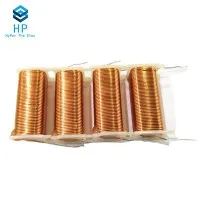


Hey there! As a supplier of Hollow Coils, I've spent a ton of time digging into all the nitty - gritty details that affect their performance. One factor that often doesn't get as much attention as it should is the inter - turn capacitance. In this blog, I'm gonna break down how this little thing can have a big impact on the performance of a hollow coil.
First off, let's quickly understand what inter - turn capacitance is. In a hollow coil, when you've got multiple turns of wire close to each other, there's an electric field that forms between these turns. This electric field gives rise to a capacitance between the turns, and that's what we call inter - turn capacitance. It's like a tiny capacitor sitting between each pair of adjacent turns in the coil.
Now, how does this inter - turn capacitance mess with the performance of a hollow coil? Well, one of the most significant effects is on the coil's resonance frequency. You see, a coil and a capacitor together form a resonant circuit. When there's inter - turn capacitance in a hollow coil, it effectively adds a capacitive element to the coil's electrical equivalent circuit.
The resonance frequency of a coil is given by the formula (f_r=\frac{1}{2\pi\sqrt{LC}}), where (L) is the inductance of the coil and (C) is the total capacitance (including the inter - turn capacitance). As the inter - turn capacitance increases, the value of (C) in the formula goes up. And according to the formula, when (C) increases, the resonance frequency (f_r) decreases.
This change in resonance frequency can be a real headache in many applications. For example, in radio frequency (RF) circuits, coils are often used as part of tuned circuits. These tuned circuits are designed to operate at specific frequencies. If the inter - turn capacitance changes the resonance frequency of the hollow coil, the tuned circuit won't work as intended. Signals at the original design frequency may not be properly processed, leading to poor signal quality, reduced sensitivity, or even complete malfunction of the RF device.
Another area where inter - turn capacitance can cause problems is in the coil's impedance. Impedance is a measure of how much a circuit resists the flow of alternating current. In a hollow coil, the impedance is a combination of the coil's inductive reactance ((X_L = 2\pi fL)) and the capacitive reactance ((X_C=\frac{1}{2\pi fC})) due to the inter - turn capacitance.


At low frequencies, the inductive reactance dominates, and the coil acts mainly as an inductor. But as the frequency increases, the capacitive reactance starts to play a more significant role. When the frequency reaches the resonance frequency of the coil - capacitance combination, the impedance of the coil reaches a minimum value. Beyond the resonance frequency, the capacitive reactance becomes larger than the inductive reactance, and the coil starts to act more like a capacitor rather than an inductor.
This change in impedance behavior can be a problem in power applications. For instance, in a power supply circuit, a hollow coil might be used as a filter inductor. If the inter - turn capacitance causes the coil to deviate from its intended impedance characteristics at certain frequencies, it won't be able to filter out unwanted frequencies effectively. This can lead to power losses, voltage fluctuations, and reduced efficiency of the power supply.
Inter - turn capacitance can also affect the coil's self - resonance. Self - resonance is the frequency at which the coil's inductance and the inter - turn capacitance create a resonant condition. When a coil operates near its self - resonance frequency, it can experience high currents and voltages. These high currents and voltages can cause excessive heating in the coil, which can damage the insulation of the wire and reduce the coil's lifespan.
In some cases, the high voltages at self - resonance can even lead to arcing between the turns of the coil. Arcing is a serious issue as it can cause permanent damage to the coil, and in extreme cases, it can pose a safety hazard.
Now, let's talk about how we can deal with inter - turn capacitance in our hollow coils. One way is to carefully design the coil's winding pattern. By increasing the distance between the turns of the coil, we can reduce the electric field between them, which in turn reduces the inter - turn capacitance. However, this approach has its limitations. Increasing the distance between turns may also increase the physical size of the coil, which may not be acceptable in applications where space is limited.
Another method is to use special insulation materials. Some insulation materials have properties that can help reduce the inter - turn capacitance. For example, materials with low dielectric constants can reduce the electric field between the turns, thus lowering the capacitance.
As a Hollow Coil supplier, we're constantly working on improving our manufacturing processes to minimize the inter - turn capacitance in our coils. We use advanced winding techniques and high - quality insulation materials to ensure that our coils have the best possible performance.
If you're in the market for high - quality coils, you might also be interested in our Encapsulated Coil and DC Solenoid Coil. These coils are designed with the same attention to detail and quality as our Hollow Coil.
If you're looking for reliable coils for your projects, whether it's for RF circuits, power supplies, or any other application, don't hesitate to reach out. We're here to provide you with the best coils that meet your specific requirements. Whether you need a custom - designed coil or a standard one, we've got you covered. Contact us to start a discussion about your coil needs and let's work together to find the perfect solution for you.
References
- "RF Circuit Design" by Chris Bowick
- "Electric Circuits" by James W. Nilsson and Susan A. Riedel