




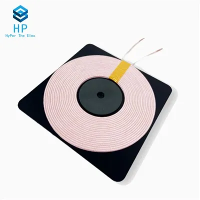

In the field of electromagnetism, DC solenoid coils play a crucial role in various applications, from industrial machinery to automotive systems. However, one persistent challenge that engineers and manufacturers face is the influence of external magnetic fields on these coils. As a leading DC solenoid coil supplier, I have witnessed firsthand the impact of external magnetic interference on the performance of our products. In this blog post, I will share some effective strategies to reduce the influence of external magnetic fields on a DC solenoid coil.
Understanding the Problem
Before delving into the solutions, it's essential to understand how external magnetic fields affect a DC solenoid coil. A DC solenoid coil generates a magnetic field when an electric current passes through it. This magnetic field is used to produce mechanical motion, such as opening or closing a valve in a Solenoid Valve Coil. However, external magnetic fields can interact with the coil's magnetic field, causing interference. This interference can lead to several issues, including reduced efficiency, inaccurate operation, and even damage to the coil over time.
External magnetic fields can originate from various sources, such as nearby electrical equipment, power lines, or even the Earth's magnetic field. The strength and direction of these external fields can vary significantly, making it challenging to predict and mitigate their effects.
Shielding Techniques
One of the most effective ways to reduce the influence of external magnetic fields on a DC solenoid coil is through shielding. Shielding involves placing a material with high magnetic permeability around the coil to redirect the external magnetic field away from the coil.
Mu-Metal Shielding
Mu-metal is a nickel-iron alloy with extremely high magnetic permeability. It is commonly used in shielding applications because it can effectively absorb and redirect magnetic fields. By enclosing the DC solenoid coil in a mu-metal shield, we can significantly reduce the amount of external magnetic field that reaches the coil.
The effectiveness of mu-metal shielding depends on several factors, including the thickness of the shield, the shape of the shield, and the orientation of the external magnetic field. In general, a thicker shield provides better shielding, but it also adds weight and cost to the system. The shape of the shield should be designed to maximize the contact area between the shield and the external magnetic field. For example, a cylindrical shield is often more effective than a flat shield for a cylindrical solenoid coil.
Conductive Shielding
In addition to mu-metal shielding, conductive shielding can also be used to reduce the influence of external magnetic fields. Conductive shields are made of materials such as copper or aluminum, which can conduct electricity. When an external magnetic field passes through a conductive shield, it induces eddy currents in the shield. These eddy currents generate a magnetic field that opposes the external magnetic field, effectively reducing its strength inside the shield.
Conductive shielding is particularly effective for high-frequency magnetic fields. However, it is less effective for low-frequency magnetic fields because the eddy currents induced in the shield are weaker at lower frequencies. To improve the effectiveness of conductive shielding for low-frequency magnetic fields, multiple layers of conductive shields can be used, or the shield can be combined with a mu-metal shield.


Coil Design Optimization
Another approach to reducing the influence of external magnetic fields on a DC solenoid coil is through coil design optimization. By carefully designing the coil's geometry, winding pattern, and materials, we can minimize its susceptibility to external magnetic interference.
Coil Geometry
The geometry of the DC solenoid coil can have a significant impact on its susceptibility to external magnetic fields. For example, a coil with a larger diameter and a shorter length is generally less susceptible to external magnetic fields than a coil with a smaller diameter and a longer length. This is because a larger-diameter coil has a larger cross-sectional area, which allows it to generate a stronger magnetic field for a given current. A stronger magnetic field is more resistant to the influence of external magnetic fields.
In addition, the shape of the coil can also affect its susceptibility to external magnetic fields. For example, a toroidal coil, which is shaped like a doughnut, is less susceptible to external magnetic fields than a cylindrical coil. This is because the magnetic field generated by a toroidal coil is confined within the coil, making it less likely to interact with external magnetic fields.
Winding Pattern
The winding pattern of the DC solenoid coil can also affect its susceptibility to external magnetic fields. For example, a coil with a bifilar winding pattern, where two wires are wound side by side in the same direction, can cancel out the external magnetic field to some extent. This is because the magnetic fields generated by the two wires are equal in magnitude but opposite in direction, so they tend to cancel each other out.
Another winding pattern that can reduce the influence of external magnetic fields is the concentric winding pattern. In a concentric winding pattern, multiple layers of wire are wound around the same axis, with each layer having a different diameter. This creates a more uniform magnetic field inside the coil, which is less susceptible to external magnetic interference.
Coil Materials
The choice of materials for the DC solenoid coil can also affect its susceptibility to external magnetic fields. For example, using a wire with a high resistivity can reduce the amount of eddy currents induced in the coil by the external magnetic field. Eddy currents can cause power losses and heating in the coil, which can reduce its efficiency and lifespan.
In addition, using a core material with high magnetic permeability can enhance the magnetic field generated by the coil, making it more resistant to the influence of external magnetic fields. Soft magnetic materials, such as iron or ferrite, are commonly used as core materials in DC solenoid coils because they have high magnetic permeability and low coercivity.
System Layout and Installation
The layout and installation of the DC solenoid coil within the system can also have a significant impact on its susceptibility to external magnetic fields. By carefully considering the placement of the coil relative to other electrical equipment and power sources, we can minimize the exposure of the coil to external magnetic fields.
Distance from External Sources
One of the simplest ways to reduce the influence of external magnetic fields on a DC solenoid coil is to increase the distance between the coil and the external sources of magnetic fields. The strength of a magnetic field decreases with the square of the distance from the source. Therefore, by increasing the distance between the coil and the external source, we can significantly reduce the strength of the external magnetic field at the location of the coil.
For example, if the DC solenoid coil is installed near a large electrical motor, moving the coil further away from the motor can reduce the influence of the motor's magnetic field on the coil. In some cases, it may be necessary to install the coil in a separate enclosure or room to isolate it from the external magnetic field.
Orientation of the Coil
The orientation of the DC solenoid coil relative to the external magnetic field can also affect its susceptibility to magnetic interference. By aligning the axis of the coil with the direction of the external magnetic field, we can minimize the amount of external magnetic field that passes through the coil.
For example, if the external magnetic field is primarily in the horizontal direction, installing the DC solenoid coil with its axis in the horizontal direction can reduce the influence of the external magnetic field on the coil. This is because the magnetic field generated by the coil is perpendicular to its axis, so aligning the axis with the external magnetic field minimizes the interaction between the two fields.
Monitoring and Testing
Finally, it is important to monitor and test the performance of the DC solenoid coil to ensure that the measures taken to reduce the influence of external magnetic fields are effective. Regular monitoring and testing can help us detect any changes in the coil's performance over time and take corrective actions if necessary.
Performance Monitoring
Performance monitoring involves measuring the electrical and mechanical parameters of the DC solenoid coil, such as the current, voltage, resistance, and force output. By comparing these parameters with the design specifications, we can determine if the coil is operating within the expected range. Any significant deviations from the design specifications may indicate the presence of external magnetic interference or other issues.
For example, if the current consumption of the coil increases unexpectedly, it may be a sign that the coil is experiencing increased resistance due to the influence of external magnetic fields. By monitoring the current consumption over time, we can detect this issue early and take corrective actions, such as adjusting the shielding or optimizing the coil design.
Magnetic Field Testing
Magnetic field testing involves measuring the strength and direction of the magnetic field around the DC solenoid coil using a magnetic field sensor. By comparing the measured magnetic field with the expected magnetic field, we can determine if there is any external magnetic interference.
For example, if the measured magnetic field around the coil is significantly different from the expected magnetic field, it may be a sign that there is an external magnetic field nearby. By using a magnetic field sensor to map the magnetic field around the coil, we can identify the source of the external magnetic field and take appropriate measures to mitigate its influence.
Conclusion
Reducing the influence of external magnetic fields on a DC solenoid coil is a complex but essential task. By using shielding techniques, optimizing the coil design, carefully considering the system layout and installation, and monitoring and testing the performance of the coil, we can effectively minimize the impact of external magnetic interference on the coil's performance.
As a DC solenoid coil supplier, we are committed to providing our customers with high-quality coils that are resistant to external magnetic fields. If you are facing challenges with external magnetic interference in your application, or if you have any questions about our products, please do not hesitate to contact us for more information and to discuss your specific requirements. We look forward to working with you to find the best solution for your needs.
References
- Cheng, D. K. (1989). Field and Wave Electromagnetics. Addison-Wesley.
- Hayt, W. H., & Buck, J. A. (2001). Engineering Electromagnetics. McGraw-Hill.
- Kraus, J. D., & Carver, K. R. (1973). Electromagnetics. McGraw-Hill.