


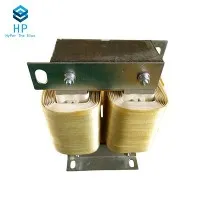



In the field of electrical engineering, the relationship between the power factor and the reactance of a Variable Reactor is a topic of great significance. As a supplier of Variable Reactors, I have witnessed firsthand how these components play a crucial role in power systems. In this blog, I will delve into the details of this relationship, explore its practical implications, and showcase the value that our Variable Reactors bring to the table.
Understanding Power Factor and Reactance
Before we discuss their relationship, let's first clarify what power factor and reactance are. Power factor is a measure of how effectively electrical power is being used in a circuit. It is defined as the ratio of real power (P), which is the power that actually does useful work, to apparent power (S), which is the product of voltage and current. A power factor of 1 indicates that all the electrical power is being used efficiently, while a lower power factor means that a significant portion of the power is being wasted.
Reactance, on the other hand, is the opposition that a circuit element offers to the flow of alternating current (AC) due to its inductance or capacitance. There are two types of reactance: inductive reactance (XL) and capacitive reactance (XC). Inductive reactance is caused by inductors, such as coils, and it increases with the frequency of the AC signal. Capacitive reactance is caused by capacitors and it decreases with the frequency of the AC signal.
The Role of Variable Reactors
A Variable Reactor is a device that allows for the adjustment of its reactance. This adjustability makes it a valuable tool in power systems, especially when it comes to power factor correction. By changing the reactance of the Variable Reactor, we can either add or subtract reactive power from the circuit, thereby improving the power factor.
In a power system, many loads, such as motors and transformers, are inductive in nature. Inductive loads draw both real power and reactive power from the source. The reactive power does not perform any useful work but causes additional current to flow in the system, leading to increased losses and reduced efficiency. A Variable Reactor can be used to counteract the inductive reactance of these loads by providing capacitive reactance. This process is known as power factor correction.
Mathematical Relationship between Power Factor and Reactance
The relationship between power factor and reactance can be expressed mathematically. The power factor (PF) is given by the formula:
PF = P / S
where P is the real power and S is the apparent power. The apparent power S can be further expressed in terms of real power P and reactive power Q as:
S = √(P² + Q²)
The reactive power Q is related to the reactance X and the current I by the formula:
Q = I²X
From these equations, we can see that by adjusting the reactance X of the Variable Reactor, we can change the reactive power Q in the circuit, which in turn affects the apparent power S and the power factor PF.


Practical Applications
The ability to adjust the reactance of a Variable Reactor has numerous practical applications in power systems. One of the most common applications is in industrial plants, where large inductive loads are prevalent. By installing Variable Reactors and adjusting their reactance, plant operators can improve the power factor of their electrical systems, reduce energy losses, and lower their electricity bills.
Another application is in power transmission and distribution systems. In these systems, the presence of inductive reactance in transmission lines can cause voltage drops and power losses. Variable Reactors can be used to compensate for this inductive reactance, thereby improving the voltage profile and the overall efficiency of the system.
Types of Variable Reactors
There are different types of Variable Reactors, each with its own characteristics and applications. Two common types are Parallel Resonant Reactors and Series Resonant Reactors.
Parallel Resonant Reactors are connected in parallel with the load. They are used to provide reactive power compensation and to improve the power factor of the system. When the reactance of the Parallel Resonant Reactor is adjusted, it can either absorb or inject reactive power into the system, depending on the requirements.
Series Resonant Reactors, on the other hand, are connected in series with the load. They are mainly used to limit the short - circuit current in the system. By adjusting the reactance of the Series Resonant Reactor, the impedance of the circuit can be changed, which affects the magnitude of the short - circuit current.
Our Variable Reactors: A Solution for Power Factor Improvement
As a supplier of Variable Reactors, we offer high - quality products that are designed to meet the diverse needs of our customers. Our Variable Reactors are built with advanced technology and high - quality materials, ensuring reliable performance and long - term durability.
We understand that every power system is unique, and that's why we provide customized solutions. Our team of experts will work closely with you to analyze your power system, determine the optimal reactance settings for your Variable Reactor, and ensure that you achieve the best possible power factor improvement.
Contact Us for Procurement
If you are looking to improve the power factor of your electrical system, reduce energy losses, or enhance the efficiency of your power transmission and distribution network, our Variable Reactors are the ideal solution. We invite you to contact us for procurement and start a discussion about how our products can meet your specific requirements. Our experienced sales team is ready to assist you with any questions you may have and to provide you with a detailed quotation.
References
- Electric Power Systems Analysis, Second Edition, by J. Duncan Glover, Mulukutla S. Sarma, Thomas J. Overbye
- Power System Analysis and Design, Fifth Edition, by John J. Grainger, William D. Stevenson, Jr., Mohammed S. El - Morshedy