


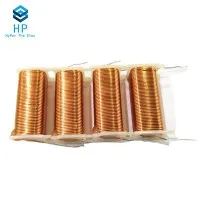

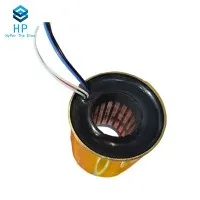

Self - inductance is a fundamental concept in electromagnetics, especially when dealing with coils. As a trusted Encapsulated Coil supplier, we delve deep into the core aspects of self - inductance in encapsulated coils to provide a clear understanding for our customers. In this blog, we will explore what self - inductance of an encapsulated coil is, its significance, factors affecting it, and more.
Understanding Self - Inductance
Self - inductance, denoted by the symbol (L), is the property of a coil by which an electromotive force (emf) is induced in the coil itself when the current flowing through it changes. According to Faraday's law of electromagnetic induction, the induced emf ((\epsilon)) in a coil is proportional to the rate of change of current ((\frac{di}{dt})) flowing through it. Mathematically, (\epsilon=-L\frac{di}{dt}), where the negative sign indicates that the induced emf opposes the change in current, as described by Lenz's law.
In the case of an encapsulated coil, the encapsulation refers to the process of enclosing the coil within a protective material. The encapsulation not only provides mechanical protection but also can influence the electrical properties of the coil, including self - inductance.
Significance of Self - Inductance in Encapsulated Coils
Self - inductance plays a crucial role in the functioning of encapsulated coils. In many electrical and electronic applications, such as power supplies, transformers, and inductors, the ability to store and release magnetic energy is essential. The self - inductance of the coil determines the amount of magnetic energy ((U)) that can be stored in the magnetic field generated by the coil. The formula for the magnetic energy stored in an inductor is (U = \frac{1}{2}Li^{2}), where (i) is the current flowing through the coil.
For example, in a AC Solenoid Coil, the self - inductance affects the impedance of the coil. The impedance ((Z)) of an AC coil is given by (Z=\sqrt{R^{2}+(\omega L)^{2}}), where (R) is the resistance of the coil, (\omega) is the angular frequency of the AC signal, and (L) is the self - inductance. A higher self - inductance will result in a higher impedance at a given frequency, which can influence the current flow and the performance of the solenoid.
Factors Affecting the Self - Inductance of an Encapsulated Coil
Number of Turns
The number of turns ((N)) of the wire in the coil is directly proportional to the self - inductance. As the number of turns increases, the magnetic field produced by the coil also increases, leading to a higher self - inductance. The self - inductance of a solenoid (a type of coil) is approximately given by (L=\mu\frac{N^{2}A}{l}), where (\mu) is the permeability of the medium inside the coil, (A) is the cross - sectional area of the coil, and (l) is the length of the coil. For an encapsulated coil, the same principle applies, and increasing the number of turns is an effective way to increase self - inductance.
Cross - sectional Area
The cross - sectional area ((A)) of the coil is also related to the self - inductance. A larger cross - sectional area allows for a greater magnetic flux, which in turn increases the self - inductance. When designing an encapsulated coil, a larger cross - sectional area can be achieved by using a wider coil or by increasing the thickness of the coil's windings.
Permeability of the Medium
The permeability ((\mu)) of the medium inside and around the coil has a significant impact on self - inductance. The encapsulated material can have different permeability values. For example, if the encapsulation material has a high magnetic permeability, it can enhance the magnetic field generated by the coil, thereby increasing the self - inductance. In some applications, magnetic core materials with high permeability are used inside the coil to boost self - inductance.
Encapsulation Material and its Properties
The encapsulation material itself can affect the self - inductance. Besides its permeability, other properties such as dielectric constant and conductivity can have secondary effects. For example, a conductive encapsulation material may introduce eddy currents, which can oppose the change in magnetic field and potentially reduce the effective self - inductance. On the other hand, a non - conductive and low - loss encapsulation material can help maintain the desired self - inductance value.
Measuring the Self - Inductance of an Encapsulated Coil
There are several methods to measure the self - inductance of an encapsulated coil. One common method is using an LCR meter. An LCR meter can directly measure the inductance, resistance, and capacitance of an electrical component. By connecting the encapsulated coil to the LCR meter, a quick and accurate measurement of the self - inductance can be obtained.
Another method is based on the principle of resonance. By creating an RLC circuit with the encapsulated coil, a capacitor, and a resistor, and then applying an AC signal, the resonant frequency ((f_{r})) of the circuit can be determined. The self - inductance ((L)) can then be calculated using the formula (f_{r}=\frac{1}{2\pi\sqrt{LC}}), where (C) is the capacitance of the capacitor in the circuit.
Applications of Encapsulated Coils with Different Self - Inductance
Encapsulated coils with various self - inductance values are used in a wide range of applications. Solenoid Valve Coils often require specific self - inductance values to ensure proper operation. In a solenoid valve, the coil's self - inductance affects the magnetic force generated, which in turn controls the opening and closing of the valve.
In power electronics, encapsulated coils with different self - inductance are used in filters. High - inductance coils can be used in low - pass filters to block high - frequency noise, while low - inductance coils may be used in high - pass filters.
Our Offerings as an Encapsulated Coil Supplier
As a leading Encapsulated Coil supplier, we understand the importance of self - inductance in different applications. We offer a wide range of encapsulated coils with precisely controlled self - inductance values. Our experienced engineering team can customize the coil design according to your specific requirements, including the number of turns, cross - sectional area, and the choice of encapsulation material.
We ensure that each encapsulated coil is produced with high - quality materials and advanced manufacturing processes to guarantee stable and accurate self - inductance. Whether you need encapsulated coils for small - scale electronic devices or large - scale industrial applications, we have the expertise and resources to meet your needs.


Contact Us for Procurement
If you are in need of high - quality encapsulated coils with specific self - inductance requirements, we are here to assist you. Our team of experts can provide detailed technical advice and support to help you select the most suitable coils for your application. Feel free to reach out to us to initiate a procurement discussion and explore how our encapsulated coils can enhance the performance of your products.
References
- Chapman, S. J. (2012). Electric Machinery Fundamentals. McGraw - Hill Education.
- Halliday, D., Resnick, R., & Walker, J. (2013). Fundamentals of Physics. Wiley.