


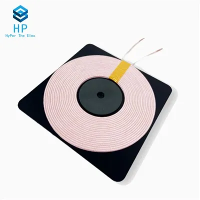


What is the temperature coefficient of an Encapsulated Coil?
As a supplier of Encapsulated Coils, I've had numerous discussions with clients, engineers, and enthusiasts about the various characteristics of these essential components. One question that often comes up is about the temperature coefficient of an Encapsulated Coil. In this blog, I'll delve into what the temperature coefficient is, why it matters, and how it relates to Encapsulated Coils.
Understanding the Temperature Coefficient
The temperature coefficient is a measure of how a physical property of a material changes with temperature. In the context of coils, we're primarily interested in the change in electrical resistance with temperature. It is usually expressed in parts per million per degree Celsius (ppm/°C). A positive temperature coefficient means that the resistance of the coil increases as the temperature rises, while a negative coefficient indicates a decrease in resistance with increasing temperature.
Let's take a simple example to illustrate this concept. Suppose we have an Encapsulated Coil with a resistance of 100 ohms at 20°C. If the coil has a positive temperature coefficient of 200 ppm/°C, and the temperature increases to 30°C (a 10°C change), the change in resistance can be calculated as follows:
The change in resistance (ΔR) is given by the formula:
[ \Delta R = R_0\times\alpha\times\Delta T ]
where ( R_0 ) is the initial resistance, ( \alpha ) is the temperature coefficient, and ( \Delta T ) is the change in temperature.
Substituting the values: ( R_0 = 100\Omega ), ( \alpha=200\times10^{- 6}/°C ), and ( \Delta T = 10°C )
[ \Delta R=100\times200\times10^{-6}\times10 = 0.2\Omega ]
So the new resistance at 30°C would be ( R = R_0+\Delta R=100 + 0.2=100.2\Omega )
Why the Temperature Coefficient Matters for Encapsulated Coils
The temperature coefficient is a crucial parameter for Encapsulated Coils for several reasons.
Performance Stability: In many applications, such as in DC Solenoid Coils and Solenoid Valve Coils, the coil's performance depends on a stable resistance. A significant change in resistance due to temperature variations can affect the magnetic field generated by the coil, which in turn can impact the operation of the solenoid or valve. For example, in a solenoid valve used in a heating system, if the coil's resistance increases too much due to the high - temperature environment, the current flowing through the coil may decrease, resulting in a weaker magnetic field and potentially causing the valve to malfunction.
Efficiency: The power dissipated in a coil is given by ( P = I^{2}R ), where ( I ) is the current and ( R ) is the resistance. If the resistance changes with temperature, the power dissipation will also change. A large increase in resistance can lead to increased power consumption, reducing the overall efficiency of the system. This is particularly important in applications where energy efficiency is a priority, such as in battery - powered devices.
Reliability: Over time, repeated temperature - induced changes in resistance can cause stress on the coil's components. This stress can lead to mechanical fatigue, wire breakage, or other forms of damage, reducing the coil's lifespan and reliability. By choosing a coil with an appropriate temperature coefficient, we can minimize these risks and ensure long - term reliable operation.
Factors Affecting the Temperature Coefficient of Encapsulated Coils
Several factors can influence the temperature coefficient of an Encapsulated Coil.
Conductor Material: The type of conductor used in the coil has a significant impact on the temperature coefficient. For example, copper has a relatively high positive temperature coefficient (around 3930 ppm/°C), while some alloys, such as constantan, have a very low temperature coefficient (close to zero). When designing an Encapsulated Coil, the choice of conductor material is often a trade - off between cost, conductivity, and temperature stability.
Encapsulation Material: The encapsulation material used to protect the coil can also affect the temperature coefficient. Some encapsulation materials have good thermal conductivity, which helps to dissipate heat from the coil more effectively, reducing temperature variations. On the other hand, materials with poor thermal conductivity can trap heat, leading to higher temperatures and potentially larger changes in resistance.
Coil Design: The physical design of the coil, such as the number of turns, wire gauge, and winding pattern, can influence how heat is generated and dissipated. A coil with a large number of turns may generate more heat, while a coil with a larger wire gauge may have lower resistance and generate less heat. Additionally, the way the coil is wound can affect its thermal properties, such as the ability to transfer heat to the encapsulation material.
Measuring the Temperature Coefficient of Encapsulated Coils
Measuring the temperature coefficient of an Encapsulated Coil typically involves taking resistance measurements at different temperatures. A common method is to use a temperature - controlled chamber to vary the temperature of the coil and a precision multimeter to measure the resistance.
The coil is first placed in the chamber at a known reference temperature (usually 20°C or 25°C), and the resistance is measured. Then, the temperature of the chamber is increased or decreased in a controlled manner, and the resistance is measured at each temperature point. The temperature coefficient can then be calculated using the formula mentioned earlier.
It's important to note that the measurement should be done under stable conditions, allowing the coil to reach thermal equilibrium at each temperature point before taking the resistance measurement. This ensures accurate and reliable results.
Selecting the Right Encapsulated Coil Based on Temperature Coefficient
When selecting an Encapsulated Coil for a specific application, it's essential to consider the temperature coefficient.
Low - Temperature Coefficient Requirements: In applications where high precision and stability are required, such as in medical devices or measurement equipment, a coil with a low temperature coefficient is preferred. This helps to minimize the impact of temperature variations on the coil's performance.
High - Temperature Environments: In applications that operate in high - temperature environments, such as automotive engines or industrial furnaces, a coil with a high - temperature - resistant encapsulation material and a suitable temperature coefficient is necessary. This ensures that the coil can withstand the elevated temperatures without significant performance degradation.
Cost - Performance Balance: In some cases, cost may be a significant factor. While coils with low temperature coefficients may offer better performance, they can also be more expensive. In such situations, a careful balance needs to be struck between the required performance and the available budget.
Conclusion
The temperature coefficient of an Encapsulated Coil is a critical parameter that affects its performance, efficiency, and reliability. As a supplier of Encapsulated Coils, we understand the importance of providing coils with the right temperature coefficient for different applications. Whether you're working on a DC Solenoid Coil project or a Solenoid Valve Coil application, we can help you select the most suitable coil based on your specific requirements.
If you're interested in learning more about our Encapsulated Coils or would like to discuss a potential purchase, please feel free to reach out. Our team of experts is ready to assist you in finding the perfect solution for your needs.


References
- "Electrical Engineering Handbook", CRC Press
- "Fundamentals of Electric Circuits", Charles K. Alexander, Matthew N. O. Sadiku