


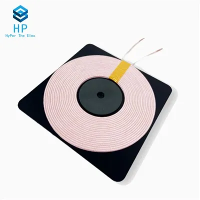
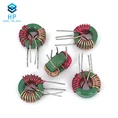

Hey there! As a supplier of toroidal inductors, I often get asked if these little components can be used in low - power circuits. Well, let's dive right into it and find out!
First off, what are toroidal inductors? They're basically inductors with a toroid - shaped core. This unique shape gives them some pretty cool advantages over other types of inductors. One of the main benefits is their low electromagnetic interference (EMI). The toroidal shape helps to contain the magnetic field within the core, which means less interference with other components in the circuit. This is super important in low - power circuits, where even a small amount of interference can mess things up.
Now, let's talk about low - power circuits. These are circuits that consume very little power, usually in the range of milliwatts or even microwatts. They're commonly found in things like battery - powered devices, sensors, and some types of portable electronics. In these circuits, efficiency is key. You want to make sure that every bit of power is used effectively, and that's where toroidal inductors can really shine.
One of the reasons toroidal inductors are great for low - power circuits is their high inductance per unit volume. They can pack a lot of inductance into a relatively small space. This is crucial in low - power devices, where space is often at a premium. For example, in a small sensor module, you might not have much room for large components. A toroidal inductor can provide the necessary inductance without taking up too much space.
Another advantage is their low resistance. In a low - power circuit, any extra resistance can lead to power losses. Toroidal inductors typically have lower resistance compared to other types of inductors, which means less power is wasted as heat. This helps to improve the overall efficiency of the circuit.
Let's take a look at some specific applications of toroidal inductors in low - power circuits. One common application is in Filter Inductor. Filter inductors are used to remove unwanted frequencies from a signal. In low - power circuits, they can be used to filter out noise and interference, ensuring that the signal remains clean and stable. For example, in a wireless sensor node, a filter inductor can help to filter out any radio frequency interference that might affect the sensor's readings.
BUCK Inductor is another area where toroidal inductors are useful. A buck converter is a type of DC - DC converter that steps down the voltage. In low - power circuits, buck converters are often used to convert the battery voltage to a lower voltage that the circuit components can use. Toroidal inductors can be used in the buck converter to store and release energy, helping to regulate the output voltage. Their high inductance and low resistance make them ideal for this application.
PFC Inductor is also an important application in low - power circuits. Power factor correction (PFC) is used to improve the efficiency of the power supply. In low - power devices, a PFC inductor can help to reduce the harmonic distortion and improve the power factor, which means that the device uses power more efficiently. Toroidal inductors are well - suited for PFC applications because of their ability to handle high frequencies and their low EMI.
However, it's not all sunshine and rainbows. There are also some challenges when using toroidal inductors in low - power circuits. One of the main challenges is the cost. Toroidal inductors can be more expensive to manufacture compared to other types of inductors. This is because of the more complex manufacturing process involved in making the toroid - shaped core. In low - power circuits, where cost is often a major consideration, this can be a drawback.
Another challenge is the limited current - handling capacity. Toroidal inductors are generally not as good at handling high currents as some other types of inductors. In low - power circuits, this might not be a big issue most of the time, but if there are sudden spikes in current, the toroidal inductor might not be able to handle it.
Despite these challenges, I still believe that toroidal inductors have a lot of potential in low - power circuits. With the right design and application, they can offer significant benefits in terms of efficiency, space savings, and performance.
If you're in the market for toroidal inductors for your low - power circuits, I'd love to have a chat with you. Whether you're working on a small sensor project or a portable electronic device, we can help you find the right toroidal inductor for your needs. Just reach out, and we can start discussing your requirements and how our toroidal inductors can fit into your design.


In conclusion, toroidal inductors can definitely be used in low - power circuits. They offer a range of advantages such as low EMI, high inductance per unit volume, and low resistance. While there are some challenges, with proper design and consideration, these can be overcome. So, if you're looking for a reliable and efficient inductor for your low - power circuit, give toroidal inductors a try.
References
- "Inductor Design Handbook" by Colonel William T. McLyman
- "Power Electronics: Converters, Applications, and Design" by Ned Mohan, Tore M. Undeland, and William P. Robbins