


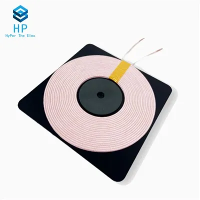
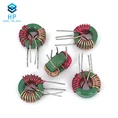

Yo, what's up everyone! I'm a supplier of toroidal inductors, and today I wanna chat about how the impulse current rating affects toroidal inductor reliability. It's a super important topic, especially if you're in the market for Filter Inductor, PFC Inductor, or BUCK Inductor.
First off, let's break down what impulse current rating is. The impulse current rating of a toroidal inductor is basically the maximum amount of current it can handle for a short period of time without getting damaged. This short - lived current surge can come from all sorts of things, like lightning strikes, sudden power switch - ons, or electrical interference in the circuit.
Now, why does this matter for reliability? Well, think about it. If your toroidal inductor can't handle the impulse currents that occur in your circuit, it's gonna start having problems. It might overheat, its magnetic properties could change, or in the worst - case scenario, it could just flat - out fail. And when an inductor fails, it can mess up the whole circuit. That's a big headache for anyone, whether you're a hobbyist building a small project or a big - time electronics manufacturer.
Let's dig a bit deeper into the different ways impulse current rating impacts reliability.


Thermal Stress
One of the main things that happens when an inductor is hit with a high - impulse current is thermal stress. When a large current flows through the inductor, the resistance in the wire causes heat to be generated. If the impulse current is too high and the inductor isn't rated to handle it, this heat can build up really quickly.
Toroidal inductors are usually made with a core and a coil of wire. The core is often made of materials like ferrite or powdered iron. These materials have specific temperature limits. If the inductor overheats due to a high - impulse current, the core material can start to lose its magnetic properties. This means that the inductance value of the inductor will change, which can throw off the performance of the circuit.
For example, in a power supply circuit, a change in the inductance of a toroidal inductor can lead to incorrect voltage regulation. The output voltage might fluctuate more than it should, or it might not be at the right level at all. This can cause damage to other components in the circuit, like integrated circuits or transistors.
Mechanical Stress
Another aspect is mechanical stress. When a high - impulse current flows through the coil of a toroidal inductor, it creates a strong magnetic field. This magnetic field can cause the turns of the coil to push against each other. If the impulse current is strong enough, it can actually deform the coil.
The mechanical structure of the inductor is designed to withstand a certain amount of stress. But if the impulse current is way beyond the rated value, the coil can start to come loose or even break. Once the coil is damaged, the inductor's performance will be severely affected, and it might not be able to function properly in the circuit anymore.
Magnetic Saturation
Magnetic saturation is also a big deal. Toroidal inductors rely on their magnetic properties to work. When a current flows through the coil, it creates a magnetic field in the core. But there's a limit to how much magnetic flux the core can handle.
If the impulse current is too high, the core can reach magnetic saturation. When this happens, the inductance of the inductor drops significantly. In a circuit, this can cause a large increase in current flow, which can lead to even more problems. For instance, in a switching power supply, magnetic saturation of the inductor can cause the switching transistors to draw too much current and potentially fail.
So, how do you make sure your toroidal inductor can handle the impulse currents in your circuit?
Choosing the Right Impulse Current Rating
When you're selecting a toroidal inductor for your project, you need to know the typical impulse currents that will occur in your circuit. This might involve some testing or using simulation software. Once you have an idea of the impulse current levels, you can choose an inductor with a suitable impulse current rating.
It's always a good idea to go for an inductor with a slightly higher impulse current rating than what you think you'll need. This gives you a bit of a safety margin. For example, if your circuit has impulse currents that peak at around 50A, it might be a good idea to choose an inductor with an impulse current rating of 60A or more.
Design Considerations
As a supplier, I've seen that proper circuit design can also help manage impulse currents. For example, you can use surge protectors or snubber circuits to reduce the magnitude of the impulse currents that reach the toroidal inductor. These additional components can absorb some of the energy from the impulse currents, protecting the inductor.
Another design consideration is the layout of the circuit. Making sure that the inductor is placed in an area with good ventilation can help with heat dissipation. Also, keeping the inductor away from other heat - generating components can prevent additional thermal stress.
Quality Manufacturing
At our company, we take quality manufacturing seriously. We use high - quality materials for our toroidal inductors. The wire we use has low resistance, which helps reduce heat generation. And we make sure that the core material is of the best quality, so it can handle the magnetic fields and temperature changes that come with impulse currents.
We also do a lot of testing on our inductors. We simulate different impulse current scenarios to make sure that our products can handle real - world conditions. This way, you can be confident that the toroidal inductors you get from us are reliable.
In conclusion, the impulse current rating of a toroidal inductor is a crucial factor for its reliability. It affects everything from thermal stress and mechanical stress to magnetic saturation. By choosing the right impulse current rating, considering proper circuit design, and going for high - quality inductors, you can ensure that your circuits will work smoothly and your inductors will last a long time.
If you're in the market for toroidal inductors, whether it's Filter Inductor, PFC Inductor, or BUCK Inductor, don't hesitate to reach out. We're here to help you find the right inductor for your needs. Let's start a conversation and get your project on the right track!
References
- "Electronics Fundamentals: Circuits, Devices, and Applications" by Thomas L. Floyd
- "Magnetic Components: Transformers and Inductors for Power Electronics" by Marian K. Kazimierczuk