


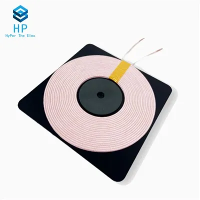
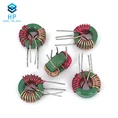

Hey there! As a choke coil supplier, I often get asked about how to measure the inductance of a choke coil accurately. It's a crucial aspect, especially for those who rely on these coils in various electronic applications. In this blog, I'll share some practical methods and tips to help you get precise inductance measurements.
First off, let's understand what a choke coil is. A Choke Coil is basically an inductor used to block high - frequency alternating current (AC) while allowing direct current (DC) or low - frequency AC to pass through. It's widely used in power supplies, audio circuits, and radio frequency (RF) equipment.
Why Accurate Inductance Measurement Matters
Accurate inductance measurement is super important. If the inductance value of a choke coil is off, it can lead to all sorts of problems. For example, in a power supply, an incorrect inductance can cause unstable power output, which might damage other components in the circuit. In RF applications, it can affect the frequency response and signal quality. So, getting it right is key.
Methods for Measuring Inductance
Using an LCR Meter
One of the most straightforward ways to measure the inductance of a choke coil is by using an LCR meter. An LCR meter is a device that can measure inductance (L), capacitance (C), and resistance (R). It's pretty easy to use.
- Set up the LCR meter: First, turn on the LCR meter and let it warm up for a few minutes. Then, select the inductance measurement mode. Most LCR meters have different ranges, so choose a range that you think is appropriate for your choke coil. If you're not sure, start with a higher range and then adjust it as needed.
- Connect the choke coil: Connect the leads of the LCR meter to the terminals of the choke coil. Make sure the connections are good and there's no loose contact. Once connected, the LCR meter will display the inductance value of the coil.
However, there are a few things to keep in mind when using an LCR meter. The accuracy of the measurement can be affected by the frequency at which the measurement is taken. Some choke coils are designed to work at specific frequencies, so it's a good idea to measure the inductance at the operating frequency of the coil. Also, external magnetic fields can interfere with the measurement, so try to keep the coil away from other magnetic sources.


The Bridge Method
Another method for measuring inductance is the bridge method. One of the commonly used bridges for inductance measurement is the Maxwell - Wien bridge.
- Understand the principle: The basic idea behind a bridge circuit is to balance the unknown inductance against known resistors and capacitors. When the bridge is balanced, the ratio of the components on one side of the bridge is equal to the ratio on the other side.
- Build or use a commercial bridge: You can either build your own Maxwell - Wien bridge using resistors, capacitors, and a null detector (like a galvanometer), or you can use a commercial bridge. Connect the choke coil to the appropriate terminals of the bridge.
- Balance the bridge: Adjust the values of the known resistors and capacitors until the null detector shows zero. At this point, the bridge is balanced, and you can calculate the inductance of the choke coil using the known values of the other components in the bridge.
The bridge method can be more accurate than using an LCR meter in some cases, especially for measuring low - value inductances. But it's also more complex and time - consuming to set up.
Using an Oscilloscope and a Function Generator
You can also measure the inductance of a choke coil using an oscilloscope and a function generator.
- Set up the circuit: Connect the choke coil in series with a known resistor to form an RL circuit. Connect the function generator to the input of the RL circuit and the oscilloscope across the resistor.
- Generate a signal: Set the function generator to output a sinusoidal signal at a known frequency. The frequency should be within the operating range of the choke coil.
- Measure the voltage and current: Use the oscilloscope to measure the voltage across the resistor. Since the current through the resistor is the same as the current through the choke coil (because they are in series), you can calculate the current using Ohm's law (I = V/R, where V is the voltage across the resistor and R is the resistance of the resistor).
- Calculate the inductance: The voltage across the choke coil can be calculated by subtracting the voltage across the resistor from the total input voltage. Then, using the relationship between voltage, current, and inductance in an AC circuit (V = I * ω * L, where ω = 2πf and f is the frequency of the signal), you can calculate the inductance of the choke coil.
This method requires some knowledge of AC circuit theory and the use of an oscilloscope and a function generator, but it can give you a good estimate of the inductance.
Tips for Accurate Measurement
- Calibration: Make sure your measuring equipment is properly calibrated. An uncalibrated LCR meter or bridge can give inaccurate results. You can calibrate your equipment using known standards.
- Temperature: The inductance of a choke coil can change with temperature. If possible, measure the inductance at the operating temperature of the coil. If you can't do that, make sure to note the temperature at which the measurement is taken and take it into account when analyzing the results.
- Lead Length: When connecting the coil to the measuring equipment, keep the lead length as short as possible. Long leads can introduce additional inductance and resistance, which can affect the measurement accuracy.
Other Types of Coils Related to Choke Coils
Choke coils are just one type of inductor. There are also Antenna Coils and Trap Coils. Antenna coils are used in antennas to help transmit and receive electromagnetic signals. Trap coils are used to block specific frequencies in a circuit. The methods for measuring the inductance of these coils are similar to those for choke coils, but the operating frequencies and design requirements may be different.
Conclusion
Measuring the inductance of a choke coil accurately is essential for ensuring the proper functioning of electronic circuits. Whether you choose to use an LCR meter, a bridge method, or an oscilloscope and function generator, make sure to follow the best practices for accurate measurement. If you have any questions or need help with measuring the inductance of our choke coils, feel free to reach out. We're here to assist you in getting the right components for your applications. If you're interested in purchasing choke coils or other related products, don't hesitate to contact us for a detailed discussion about your requirements.
References
- "Electronic Measurements and Instrumentation" by David A. Bell
- "The Art of Electronics" by Paul Horowitz and Winfield Hill