




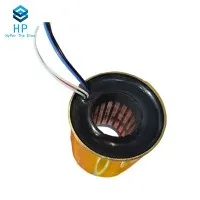
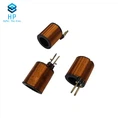
What is the dynamic behavior of an oscillating coil?
As a long - standing supplier of oscillating coils, I've had the privilege of witnessing firsthand the fascinating and complex dynamic behavior of these essential components. Oscillating coils, also known as resonant or tuned coils, play a crucial role in a wide range of electronic devices, from radio receivers to advanced communication systems. In this blog post, I'll delve into the dynamic behavior of oscillating coils, exploring how they work, the factors that influence their performance, and their practical applications.
The Basics of Oscillating Coils
An oscillating coil is a type of inductor that is designed to work in conjunction with a capacitor to create an LC circuit. When an alternating current (AC) is applied to an LC circuit, the energy oscillates back and forth between the magnetic field stored in the coil and the electric field stored in the capacitor. This oscillation occurs at a specific frequency known as the resonant frequency, which is determined by the values of the inductance (L) of the coil and the capacitance (C) of the capacitor, according to the formula (f = \frac{1}{2\pi\sqrt{LC}}).
The dynamic behavior of an oscillating coil is characterized by its ability to store and transfer energy between the magnetic and electric fields. When the current through the coil changes, the magnetic field around the coil also changes. According to Faraday's law of electromagnetic induction, this changing magnetic field induces an electromotive force (EMF) in the coil, which opposes the change in current. This property, known as inductance, is what allows the coil to store energy in its magnetic field.
Factors Influencing the Dynamic Behavior
Several factors can influence the dynamic behavior of an oscillating coil. One of the most important factors is the quality factor (Q) of the coil. The Q factor is a measure of the efficiency of the coil in storing and transferring energy. A high - Q coil has low resistance and can store energy for a longer time, resulting in a more stable and well - defined resonant frequency. The Q factor is affected by the materials used in the coil, the winding technique, and the operating frequency.
The physical dimensions of the coil also play a significant role in its dynamic behavior. The number of turns, the diameter of the wire, and the core material all affect the inductance of the coil. A coil with more turns will generally have a higher inductance, while a larger - diameter wire will result in lower resistance and a higher Q factor. The core material can also enhance the magnetic field of the coil, increasing its inductance. For example, a ferrite core can significantly increase the inductance compared to an air - core coil.


Temperature is another factor that can affect the dynamic behavior of an oscillating coil. As the temperature changes, the resistance of the wire in the coil changes, which can in turn affect the Q factor and the resonant frequency. Additionally, the physical properties of the core material may also change with temperature, further influencing the inductance of the coil.
Applications of Oscillating Coils
Oscillating coils are used in a wide variety of applications due to their unique dynamic behavior. In radio frequency (RF) circuits, oscillating coils are used in resonant circuits to select specific frequencies. For example, in a radio receiver, an oscillating coil can be used in a tuning circuit to select a particular radio station. The coil and capacitor combination can be adjusted to resonate at the frequency of the desired station, allowing the receiver to pick up the signal while rejecting others.
In communication systems, oscillating coils are used in oscillators to generate stable RF signals. These signals are used for various purposes, such as transmitting information over long distances. For example, in a mobile phone, an oscillator using an oscillating coil generates the carrier signal that is modulated with the voice or data information.
Oscillating coils are also used in electronic filters. Trap Coil is a type of coil used in filters to block specific frequencies while allowing others to pass through. By carefully selecting the inductance and capacitance values, a trap coil can be designed to resonate at the frequency that needs to be blocked, effectively filtering it out of the signal.
In power electronics, oscillating coils can be used in resonant converters. These converters use the resonant behavior of the coil - capacitor combination to achieve high - efficiency power conversion. The oscillating coil helps to reduce switching losses and improve the overall performance of the converter.
Comparison with Other Types of Coils
It's important to note the differences between oscillating coils and other types of coils, such as Resonant Coil and Trap Coil. While all these coils are based on the principles of electromagnetic induction, they have different design goals and applications.
A resonant coil, like an oscillating coil, is designed to operate at a specific resonant frequency. However, resonant coils are often used in more specialized applications, such as wireless power transfer systems. In these systems, the resonant coil is used to transfer power wirelessly between a transmitter and a receiver by creating a resonant magnetic field.
A trap coil, on the other hand, is primarily used for filtering out unwanted frequencies. It is designed to have a high impedance at the frequency that needs to be blocked, while having a low impedance at other frequencies. This allows it to selectively remove specific frequencies from a signal.
Our Role as a Supplier
As a supplier of Oscillating Coil, we understand the importance of providing high - quality coils that meet the specific requirements of our customers. We use advanced manufacturing techniques and high - quality materials to ensure that our coils have excellent dynamic behavior, with high Q factors and stable resonant frequencies.
We work closely with our customers to understand their applications and design coils that are optimized for their needs. Whether it's a high - frequency RF application or a power electronics system, we have the expertise to develop custom - designed oscillating coils. Our team of engineers can provide technical support and guidance throughout the product development process, from design to testing.
Contact for Purchase and Collaboration
If you're in the market for high - quality oscillating coils, we invite you to reach out to us for more information. Our experienced sales team is ready to assist you with your inquiries and provide you with detailed product specifications and pricing. Whether you're looking for standard coils or custom - designed solutions, we have the capabilities to meet your requirements. Don't hesitate to contact us to start a productive discussion about your oscillating coil needs.
References
- Paul Horowitz and Winfield Hill, "The Art of Electronics," Cambridge University Press, 2015.
- Thomas H. Lee, "The Design of CMOS Radio - Frequency Integrated Circuits," Cambridge University Press, 1998.
- Albert Paul Malvino and David P. Leach, "Electronic Principles," McGraw - Hill, 1993.