



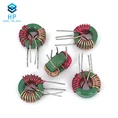

Hey there! As a supplier of saturated reactors, I often get asked about the principle of saturation in these nifty devices. So, let's dive right in and break it down in a way that's easy to understand.
What's a Saturated Reactor Anyway?
Before we get into the principle of saturation, let's quickly talk about what a saturated reactor is. A saturated reactor is a type of electrical reactor whose inductance can be controlled by varying the magnetic saturation of its core. It's used in a bunch of applications, like voltage regulation, power factor correction, and harmonic filtering.
The Basics of Magnetism in Reactors
To understand the principle of saturation, we first need to have a basic understanding of magnetism in reactors. A reactor consists of a coil of wire wound around a magnetic core. When an electric current flows through the coil, it creates a magnetic field around the core. The strength of this magnetic field is proportional to the current flowing through the coil.
The magnetic core plays a crucial role here. It's made of a ferromagnetic material, like iron or steel, which can enhance the magnetic field produced by the coil. The relationship between the magnetic field strength (H) and the magnetic flux density (B) in the core is described by the magnetization curve.
The Magnetization Curve
The magnetization curve, also known as the B-H curve, shows how the magnetic flux density (B) in the core changes with the magnetic field strength (H). At low values of H, the relationship between B and H is linear. This means that as the current in the coil increases, the magnetic flux density in the core increases proportionally.
However, as the magnetic field strength continues to increase, something interesting happens. The core starts to approach a state called saturation. In saturation, the magnetic domains in the core are all aligned in the direction of the magnetic field, and further increases in the magnetic field strength don't result in a significant increase in the magnetic flux density.
The Principle of Saturation
So, what exactly is the principle of saturation in a saturated reactor? Well, it all boils down to the fact that the inductance of a reactor is directly related to the magnetic flux density in its core. When the core is unsaturated, the inductance is relatively high because the magnetic flux density can increase easily with the current.
But as the core approaches saturation, the inductance starts to decrease. This is because the magnetic flux density doesn't increase as much with the current, and the reactor becomes less effective at storing magnetic energy. In other words, the reactor's ability to oppose changes in current decreases.
In a saturated reactor, we can control the inductance by varying the DC bias current flowing through a separate control winding. By increasing the DC bias current, we can increase the magnetic field strength in the core and push it closer to saturation. This, in turn, reduces the inductance of the reactor.
Applications of Saturated Reactors
Now that we understand the principle of saturation, let's take a look at some of the applications of saturated reactors.
Voltage Regulation
One of the most common applications of saturated reactors is voltage regulation. In power systems, the voltage can fluctuate due to changes in load or other factors. A saturated reactor can be used to regulate the voltage by adjusting its inductance. By changing the DC bias current, we can control the amount of reactive power flowing through the reactor and maintain a stable voltage.
Power Factor Correction
Another important application is power factor correction. In electrical systems, a low power factor can lead to increased energy consumption and higher electricity bills. A saturated reactor can be used to improve the power factor by compensating for the reactive power in the system. By adjusting the inductance of the reactor, we can ensure that the system operates at a near-unity power factor.
Harmonic Filtering
Saturated reactors can also be used for harmonic filtering. Harmonics are unwanted frequencies that can cause problems in electrical systems, like overheating of equipment and interference with communication systems. A saturated reactor can be designed to resonate at specific harmonic frequencies and filter them out of the system.
Types of Reactors Related to Saturated Reactors
There are a few other types of reactors that are related to saturated reactors, such as Variable Reactor, Parallel Resonant Reactor, and Series Resonant Reactor.
A variable reactor, as the name suggests, has a variable inductance that can be adjusted. This can be useful in applications where the load conditions change frequently. A parallel resonant reactor is used in parallel with a load to create a resonant circuit at a specific frequency. This can be used for power factor correction or harmonic filtering. A series resonant reactor is used in series with a load to create a resonant circuit at a specific frequency. This can be used to filter out specific harmonic frequencies.
Advantages of Saturated Reactors
Saturated reactors offer several advantages over other types of reactors. One of the main advantages is their ability to provide continuous control of the inductance. This allows for precise regulation of voltage, power factor, and harmonic filtering.
Another advantage is their high reliability. Saturated reactors have a simple design and few moving parts, which makes them less prone to failure. They also have a long lifespan and require minimal maintenance.


Conclusion
In conclusion, the principle of saturation in a saturated reactor is based on the relationship between the magnetic flux density and the magnetic field strength in the core. By controlling the DC bias current, we can vary the inductance of the reactor and use it for a variety of applications, like voltage regulation, power factor correction, and harmonic filtering.
If you're in the market for a saturated reactor or any of the related types of reactors, like Variable Reactor, Parallel Resonant Reactor, or Series Resonant Reactor, feel free to reach out. We'd be happy to discuss your specific requirements and help you find the right solution for your application.
References
- Electric Machinery Fundamentals by Stephen J. Chapman
- Power System Analysis and Design by J. Duncan Glover, M. S. Sarma, and Thomas J. Overbye