




Hey there! As an Antenna Coil supplier, I've been getting a lot of questions lately about the relationship between the inductance and the number of turns of an Antenna Coil. So, I thought I'd take a few minutes to break it down for you.
First off, let's talk about what inductance is. In simple terms, inductance is a measure of how much a coil resists changes in the current flowing through it. It's kind of like inertia for electrical current. The higher the inductance, the more the coil will resist changes in current.
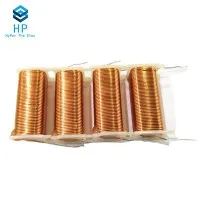
Now, let's get to the number of turns. The number of turns in an Antenna Coil refers to how many times the wire is wrapped around the core. This is a crucial factor because it directly affects the coil's inductance.
So, what's the relationship between the two? Well, it's actually a pretty straightforward one. The inductance of an Antenna Coil is proportional to the square of the number of turns. That means if you double the number of turns in a coil, the inductance will increase by a factor of four. If you triple the number of turns, the inductance will increase by a factor of nine, and so on.
This relationship can be expressed by the following formula:
L = (μ₀ * μᵣ * N² * A) / l
Where:
- L is the inductance of the coil
- μ₀ is the permeability of free space (a constant value)
- μᵣ is the relative permeability of the core material
- N is the number of turns in the coil
- A is the cross - sectional area of the coil
- l is the length of the coil
From this formula, you can clearly see that N² has a direct impact on the inductance. If you increase N, the value of N² will increase significantly, which in turn increases L.
But why does this matter? Well, in the world of antennas, inductance plays a vital role. Antennas are designed to transmit and receive electromagnetic waves. The inductance of the Antenna Coil affects the resonant frequency of the antenna. The resonant frequency is the frequency at which the antenna operates most efficiently. By adjusting the number of turns and thus the inductance, we can tune the antenna to the desired frequency.
For example, if you're building an antenna for a specific radio frequency band, you need to make sure the Antenna Coil has the right inductance. You can do this by carefully choosing the number of turns. A higher number of turns will increase the inductance, which will lower the resonant frequency. Conversely, a lower number of turns will decrease the inductance and raise the resonant frequency.
Now, there are different types of coils related to Antenna Coils, such as Trap Coil and Choke Coil. Trap Coils are used to block certain frequencies, while Choke Coils are used to filter out unwanted high - frequency noise. The same principle of the relationship between inductance and the number of turns applies to these coils as well.
When we're manufacturing Antenna Coils, we have to be really precise about the number of turns. We use advanced machinery to ensure that each coil has the exact number of turns required to achieve the desired inductance. This precision is what allows us to provide high - quality Antenna Coils to our customers.
Another thing to consider is the core material. As mentioned in the formula, the relative permeability (μᵣ) of the core material also affects the inductance. Different core materials have different permeabilities. For example, a ferrite core has a much higher permeability than an air core. So, for the same number of turns, a coil with a ferrite core will have a higher inductance than a coil with an air core.
We offer a wide range of Antenna Coils with different core materials, depending on our customers' needs. Whether you need a coil for a high - frequency application or a low - frequency one, we can customize the number of turns and the core material to meet your specific requirements.
In addition to the inductance and the number of turns, other factors can also influence the performance of an Antenna Coil. These include the wire gauge, the spacing between the turns, and the shape of the coil. For instance, a closely - wound coil will have a different inductance characteristic compared to a loosely - wound coil.
At our company, we've been in the business of supplying Antenna Coils for many years. We've gained a wealth of experience and knowledge in this field. We constantly research and develop new technologies to improve the performance of our coils.
If you're in the market for high - quality Antenna Coils, we'd love to hear from you. We can provide you with detailed information about our products and help you choose the right coil for your application. Whether you're a small - scale hobbyist or a large - scale manufacturer, we have the expertise and the resources to meet your needs.
So, if you're interested in learning more about our Antenna Coils or have any questions about the relationship between inductance and the number of turns, don't hesitate to reach out. We're here to help you make the best decision for your project.
In conclusion, the relationship between the inductance and the number of turns of an Antenna Coil is a fundamental concept in antenna design. By understanding this relationship, you can better optimize the performance of your antennas. And if you need reliable Antenna Coils, we're the supplier you can trust.
References


- Electromagnetics textbooks such as "Introduction to Electrodynamics" by David J. Griffiths
- Antenna engineering handbooks and research papers on antenna coil design.